
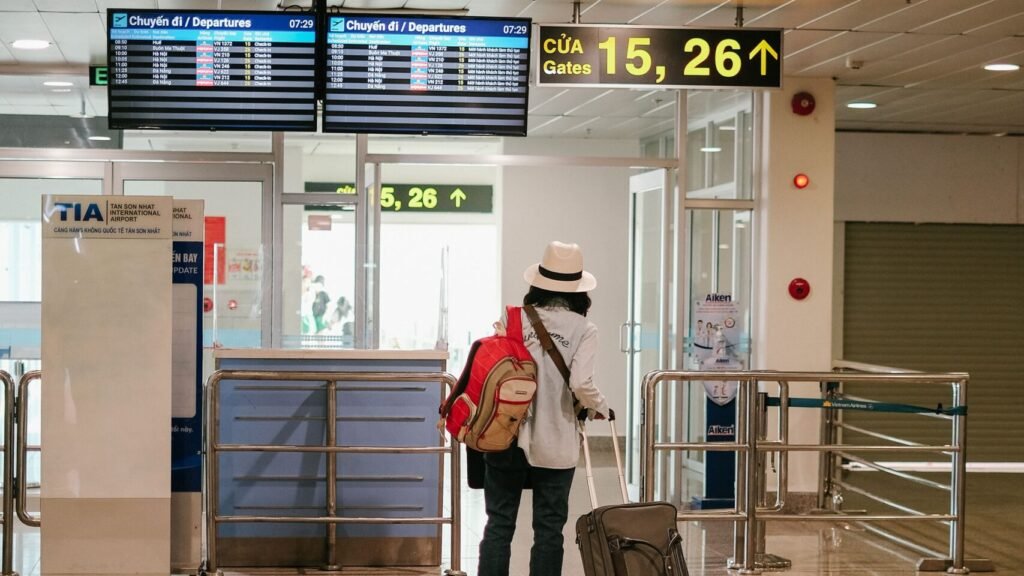
Checking in for a flight can take less time than finding a parking space at the airport. If you are checking in on your phone, traveling with only a carry-on, and nothing unusual pops up, you may be finished in five or ten minutes.
When an airline tells you to arrive two hours before a domestic flight or three hours before an international flight, it does not mean checking in takes two or three hours. Check-in is only one piece of the trip from the airport entrance to your seat on the plane.
You may still have to park, ride a shuttle, check a suitcase, clear security, walk across a large terminal, and reach your gate before boarding closes.
Quick Answer
For planning purposes, allow approximately:
- Online or airline app check-in: 3–10 minutes
- Airport kiosk: 5–15 minutes once a machine is available
- Bag drop: 10–30 minutes, including a possible wait
- Staffed airline counter: 15–45 minutes, including a possible wait
- International check-in with document review: 20–60 minutes, including a possible wait
- Ticket, document, or other problems: 30 minutes to an hour or more
These are rough planning estimates, not published airline averages or guaranteed completion times. The airport ranges cover different ways of checking in and should not all be added together. A kiosk visit followed by bag drop, however, can involve two separate waits.
For airport arrival, at least two hours before a domestic flight and three hours before an international flight is a common starting point supported by airline recommendations. Check your operating airline’s guidance for your airport and itinerary, since some situations require more time.
A quiet airport on a Tuesday afternoon can look very different from a major airport during a holiday travel rush.
What Does Checking In Actually Do?
Checking in tells the airline that you intend to take the flight and normally gives you access to your boarding pass.
It does not necessarily mean that everything else is finished.
You may still need to have a checked bag accepted by the airline. An international traveler may need a passport or other document verified in person. And everyone still has to meet the airline’s deadlines for baggage and boarding.
These stages have different meanings:
- Check-in: Completing the airline’s check-in process.
- Bag-drop deadline: The time by which the airline must accept your checked luggage.
- Security screening: The separate process of getting through the airport security checkpoint.
- Boarding time: When passengers begin entering the aircraft.
- Gate or boarding deadline: When you must be at the gate and available to board.
- Departure time: When the flight is scheduled to leave, generally from the gate rather than the runway.
If your flight departs at 10:00 a.m., 10:00 is definitely not the time to be wandering toward the gate with a fresh cup of coffee.
The Easiest Check-In: Your Phone
For a straightforward trip, checking in through the airline’s website or app is usually the quickest option because it can eliminate an airport check-in line.
Many major U.S. airlines offer online check-in beginning around 24 hours before departure, although eligibility and cutoff times vary.
If the app lets you check in, you can usually confirm your information, review your seat, deal with baggage options, and receive your boarding pass.
For one traveler with a simple reservation, allowing three to ten minutes is a practical estimate. Several passengers, seat changes, baggage purchases, or an international itinerary may take longer.
Once you have the boarding pass, save it somewhere easy to reach. The airline app or your phone wallet works well. Keeping the confirmation number somewhere separate is also useful in case the app decides that the airport is the perfect place to stop cooperating.
Can You Check-In Online and Go Straight to Security?
Often, yes. You can generally proceed directly to security if you:
- Have completed check-in and received a valid boarding pass.
- Are traveling with carry-on luggage only.
- Do not need an airline document check or other counter service.
- Have not been instructed by the airline to see an agent.
Keep your boarding pass and any required identification accessible. For adults using a state-issued driver’s license or identification card at a U.S. TSA checkpoint, check that it meets REAL ID requirements, or bring another TSA-accepted form of identification, such as a passport.
If you have checked luggage, you must drop it off before going through security. If the app says that documents need verification, follow that instruction even if you have completed part of check-in online.
Checking In at an Airport Kiosk
Airport kiosks are useful when you did not check in before leaving home, need a printed boarding pass, or need to print bag tags.
Once you reach an available machine, allow approximately five to fifteen minutes as a planning estimate. A straightforward boarding-pass printout may take less time; difficulties with a reservation or baggage payment can take longer.
Depending on the airline and airport, the kiosk may allow you to:
- Check in.
- Print a boarding pass.
- Confirm or change a seat.
- Pay for checked luggage.
- Print baggage tags.
Printing a baggage tag is not the same as handing the bag over to the airline.
You still have to take the suitcase to the designated bag-drop area and complete the airline’s baggage-acceptance process.
That distinction becomes very important when you are running late.
When You Need the Airline Counter
Sometimes the old-fashioned human being behind the counter is exactly what you need.
A staffed counter may be necessary when the airline needs to verify travel documents, correct a ticket or name problem, handle a changed reservation, check a pet or special item, assist an unaccompanied minor, or solve a problem the app cannot.
The conversation with the agent may be brief. The unpredictable part is the line in front of you and whether your situation needs additional work.
Allowing about 15 to 45 minutes is a rough planning range, including a possible wait. During a holiday rush, weather disruption, or major airline problem, it can take considerably longer.
If you know before leaving home that you will need an agent, build extra time into your airport arrival.
Checked Bags Change the Equation
Checking in online does not make a suitcase magically travel from your bedroom to the airplane.
Even if you paid the baggage fee online and printed the tag yourself, the airline still has to accept the bag before its cutoff time.
A traveler who checks in at home in five minutes may therefore face a separate bag-drop line at the airport. Allow roughly 10 to 30 minutes for planning, with more time when lines are heavy.
Allow additional time if a suitcase is overweight or oversized, a tag will not print, you are traveling with special equipment, or the airline sends you to a different baggage area.
And weigh questionable bags at home if you can. Opening a suitcase on the airport floor and deciding which pair of shoes deserves to continue the vacation is not an ideal beginning to a trip.
Keep the baggage receipt after the airline accepts the suitcase. It contains information that can be useful if the bag does not arrive when you do.
Why International Check-In Can Take Longer
International check-in may involve verifying that you have the documents required for the trip.
Depending on your nationality, destination, and itinerary, that can involve a passport, visa or electronic travel authorization, residency documentation, transit requirements, or other entry information.
You may still be able to check in through the airline’s app. Some airlines also offer digital document verification. However, completing online check-in does not guarantee that you can bypass an agent.
If the app tells you to see an agent or says that documents need verification, build time into your airport arrival for that step.
The 20-to-60-minute range is a planning allowance for check-in, possible waiting, and document review—not a claim that reviewing a passport itself takes that long.
This is one reason airlines recommend additional time for international travel. The check-in transaction probably will not consume three hours; the extra time gives you room for the other steps and unexpected delays.
What If Online Check-In Doesn’t Work?
Don’t immediately assume something terrible has happened to your reservation.
The airline may need to verify documents, direct you to the operating carrier on a partner itinerary, review a changed reservation, or handle a service that cannot be completed online. A technical problem is another possibility.
Read the message on the screen.
If it tells you to see an agent, plan to see an agent. Taking a screenshot of the message can also be useful.
Avoid repeatedly changing the reservation simply to persuade the app to issue a boarding pass. Follow the airline’s instructions, and contact it if the message is unclear.
Sometimes the fastest solution to a computer problem at an airport is a person wearing an airline badge.
How Early Should You Get to the Airport?
A common starting point is at least two hours before a domestic flight and three hours before an international flight.
American and Delta publish recommendations along those lines. They also list exceptions and earlier deadlines for particular airports and routes.
Consider adding more time when you have checked luggage, are traveling during a holiday, need assistance, are traveling with children, are unfamiliar with the airport, need a document check, have special baggage, are returning a rental car, or must take a shuttle from remote parking.
A frequent traveler with a boarding pass, TSA PreCheck, and one small carry-on may move through the airport differently from a family arriving for its first flight with several suitcases, a stroller, and car seats.
Both still need to meet their airline’s deadlines.
Why Airlines Recommend Arriving Two Hours Early
Here is an illustrative domestic-flight planning example:
- Check-in and bag drop: 25 minutes
- Security screening: 30 minutes
- Walk to the gate: 15 minutes
- Time at the gate before departure for boarding: 30 minutes
- Allowance for unexpected delays: 20 minutes
Total: 25 + 30 + 15 + 30 + 20 = 120 minutes, or two hours.
These numbers illustrate how the time can add up. They are not measured averages or an airline-prescribed schedule. Security could be much quicker or much slower, and your flight may require you to reach the gate earlier than this example allows.
Parking, rental-car returns, and travel to the terminal would need their own allowance.
Don’t Confuse the Check-In Deadline With the Boarding Deadline
Airlines have separate deadlines for checking in, accepting baggage, and getting passengers onto the aircraft. Those deadlines vary by airline, airport, and route.
Having a boarding pass on your phone does not override a checked-bag cutoff.
Clearing security does not guarantee you can board if you reach the gate after boarding has closed.
And seeing the airplane sitting outside the window does not mean the airline can reopen the door and put you on it.
For example, Delta generally requires domestic travelers without checked bags to complete check-in at least 30 minutes before departure, while baggage usually must be checked at least 45 minutes before departure. It requires passengers to be at the gate and ready to board at least 15 minutes before domestic departure. Airport exceptions apply.
Those are deadlines, not comfortable arrival targets. Check the operating airline’s current requirements for your particular flight and work backward from when you need to be at the gate.
A Little Preparation Can Save a Lot of Airport Time
The day before the flight, confirm the airport and terminal, check in when the airline allows it, review baggage rules, make sure everyone’s name is correct, and physically locate the identification or passports you will need.
Before leaving home, check the flight status and any airport advisories. Check again when you arrive, and monitor the gate information while you are at the airport.
Flights change gates. Weather happens. Apps update.
If you are traveling with children, divide the work when possible. One adult can handle documents and airline questions while another keeps track of children and bags. If older children can manage their own small carry-on, give them something they can realistically handle rather than turning them into junior baggage handlers.
TSA generally does not require identification from children under 18 traveling within the United States, but airlines may have their own requirements. International travel has separate document requirements.
If you need wheelchair or other airport assistance, request it from the airline as early as practical and allow additional time. Let airline staff know you have arrived and need the assistance requested.
TSA Cares offers help concerning security screening; it is separate from arranging an airline wheelchair or assistance through the terminal.
What If You’re Running Late?
If the airline’s online check-in window is still open, check in through the app as soon as you can safely do so.
If you need counter service or have a checked bag, go directly to the correct airline location and tell an employee that your deadline is approaching. If you are already checked in with carry-on luggage only, follow the airline’s instructions and proceed toward security and your gate.
If you have missed a cutoff, the airline may refuse to accept a checked bag or require rebooking. Reservation cancellation, standby options, fees, and no-show consequences depend on the airline and ticket conditions.
Do not assume a delayed departure automatically extends check-in or baggage deadlines. Follow the airline’s instructions; some deadlines are based on the original scheduled departure.
At that point, the useful question is not, “But I can see the plane.”
The useful question is, “What are my options now?”
Related Articles
If you’re planning a trip, these guides can help you prepare for boarding, arrival, and the unexpected:
- How Long Does It Take to Get Through Airport Security?
- How Long Does It Take to Board a Plane?
- How Long Does It Take to Deplane a Flight?
- How Long Does It Take to Get Through Customs?
- How Long Does It Take to Get Travel Insurance?
Frequently Asked Questions
When should I check in for a flight?
American, Delta, and Southwest offer online check-in beginning around 24 hours before departure, subject to eligibility and itinerary rules. Checking in when the window opens gives you more time to deal with a document, app, or reservation problem.
How long does online check-in take?
For a straightforward reservation, three to ten minutes is a rough planning estimate. Adding baggage, reviewing seats, entering documents, or checking in several passengers may take longer. This is not a published airline average.
How long does airport check-in take?
Allow roughly five to fifteen minutes at an available kiosk, or about 15 to 45 minutes for a staffed counter including a possible wait. International document review or reservation problems may require more time. These are planning estimates; queues can exceed them.
How early should I arrive for a domestic flight?
At least two hours before departure is a common airline recommendation. Follow any earlier guidance from your airline or airport, especially during busy periods or when you need extra services.
How early should I arrive for an international flight?
At least three hours before departure is a common starting point. Check your operating airline’s guidance for the particular airport and itinerary because earlier arrival or check-in requirements may apply.
Do I have to check in if I don’t have checked luggage?
Yes. You still need to be checked in for the flight. If you receive a valid boarding pass, have the required identification, and do not need an airline document check or other counter service, you can often proceed directly to security.
Does paying for a checked bag online mean the bag is checked?
No. Paying for baggage or printing a tag does not complete the physical handover. The airline still has to accept your bag before its baggage deadline.
Why can’t I get my boarding pass online?
You may need document verification, assistance from the operating airline, or help resolving a reservation or technical issue. Follow the message in the app or website and allow time to see an agent if instructed.
Is departure time the same as boarding time?
No. Boarding takes place before scheduled departure. Use the boarding time and gate deadline provided by the operating airline.
Can I check in online for an international flight?
Often, yes. Depending on the airline and itinerary, documents may be verified digitally or may require an in-person check. Follow the airline’s instructions before assuming you can bypass the counter.
What happens if I miss the check-in deadline?
You may be unable to check in for that flight and need to be rebooked. Missing a baggage deadline can also prevent your suitcase from being accepted, even if you already have a boarding pass. Contact the airline promptly to discuss your options and any effect on the remaining reservation.
Quick Summary
Checking in for a flight is usually one of the quicker parts of air travel. As rough planning estimates, allow three to ten minutes online, five to fifteen minutes at an available kiosk, or 15 to 45 minutes for a staffed counter including a possible wait.
Checked bags, document reviews, special items, and reservation problems can add time. These ranges are not airline averages and do not cover the entire airport journey.
Use your airline’s airport-arrival guidance, baggage deadline, and gate requirements together. A quick check-in still leaves security, the walk to your gate, and boarding.
Sources & References
- Transportation Security Administration — How Early Should I Arrive at the Airport?
- Transportation Security Administration — Acceptable Identification at the TSA Checkpoint
- Transportation Security Administration — Do Minors Need Identification to Fly Within the U.S.?
- Transportation Security Administration — TSA Cares
- U.S. Department of Transportation — Wheelchair and Guided Assistance
- U.S. Department of State — International Travel Checklist
- American Airlines — Check-In and Arrival
- Delta Air Lines — Check-In Times at U.S. Airports
- Delta Air Lines — Check-In Times at U.S. Airports
- Delta Air Lines — International Check-In Requirements
- Southwest Airlines — Online Check-In
- Southwest Airlines — When to Arrive for Your Flight
Editorial Review
Reviewed by Claire Bennett, Managing Editor
Last reviewed: October 2026
Quick Answer Guide publishes practical, research-based answers and stories about travel, home improvement, technology, places, and everyday life. Content is reviewed using official government resources, educational institutions, industry publications, airline policies, and other authoritative sources when appropriate. Articles are updated periodically to improve accuracy and usefulness.