
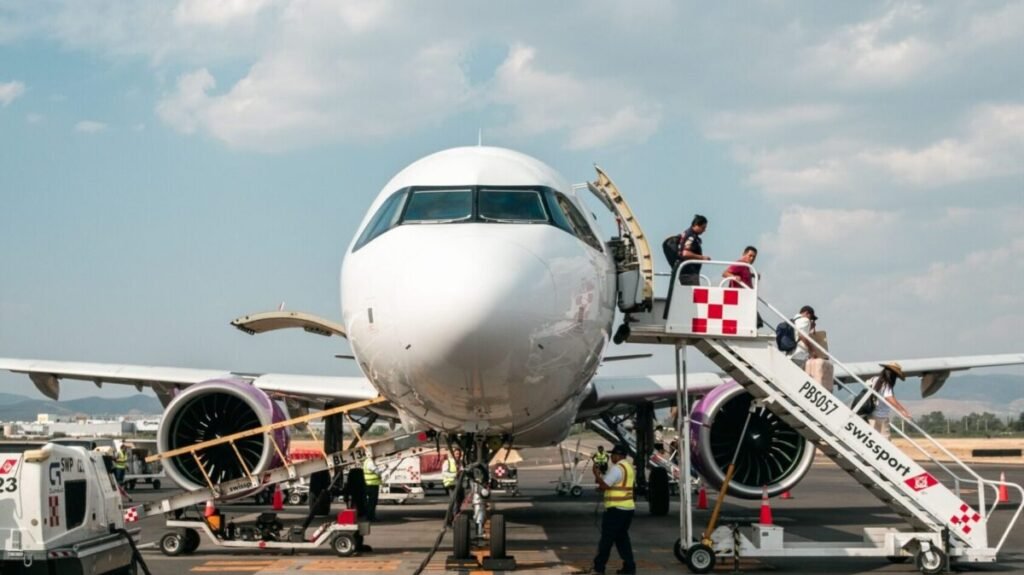
Deplaning a flight usually takes about 5 to 30 minutes after the aircraft door opens, depending on the size of the plane, where you are seated, how much carry-on luggage passengers have, and whether the aircraft uses a jet bridge, stairs, or a shuttle bus.
That is only one part of the arrival, however. After the wheels touch the runway, the aircraft must taxi to a gate or parking position, ground employees must secure it, and the crew must receive confirmation that it is safe to open the door. If you checked a bag or arrived from another country, baggage claim and border processing come afterward.
For planning purposes, many travelers should allow about 15 to 45 minutes from touchdown until they enter the terminal. Reaching baggage claim, a connecting gate, customs, or a pickup area can take considerably longer. A busy airport, an unavailable gate, a remote parking stand, or a large international aircraft can turn an otherwise routine arrival into a much longer process.
Quick Answer
Most passengers get off a plane within 5 to 30 minutes after the door opens. A traveler near the front of a smaller aircraft may step into the terminal within a few minutes. Someone near the back of a full narrow-body plane may wait 15 to 25 minutes, and leaving a large wide-body aircraft can take 30 minutes or longer.
A practical way to plan is:
- Touchdown to the gate: commonly 5 to 20 minutes
- Parking, securing the aircraft, and opening the door: commonly 2 to 8 minutes
- Your seat to the aircraft door: commonly 5 to 30 minutes
- Touchdown to the terminal: often 15 to 45 minutes in ordinary conditions
- Touchdown to baggage claim or an airport exit: often 30 to 75 minutes
- International arrival including immigration, baggage, and customs: often 45 minutes to 2 hours or longer
These are planning ranges, not guaranteed schedules. Airport layout, gate availability, passenger volume, weather, staffing, and additional inspections can change the timing substantially.
What Does “Arrival Time” Actually Mean?
One of the most useful details for travelers is that an airline’s listed arrival time generally refers to arrival at the gate, not the moment the wheels touch the runway.
For U.S. airline performance reporting, the Bureau of Transportation Statistics defines gate arrival as the time the pilot sets the aircraft’s parking brake at the arrival gate or another passenger-unloading area. If that procedure is not used, the opening of the passenger door may be used. This is why a flight can land before its scheduled arrival time but appear to arrive only a few minutes early—or even late—after a long taxi or a wait for a gate.
Four different moments are often mixed together:
- Touchdown: The wheels reach the runway.
- Gate arrival: The aircraft reaches its parking position.
- Door opening: Ground conditions are safe and the crew opens the aircraft.
- Personal deplaning time: You leave your seat and pass through the aircraft door.
If someone is picking you up, “We landed” does not mean “I am outside.” A better message is, “We just reached the gate,” followed by an update after you leave the aircraft or collect your bag.
Typical Deplaning Timeline
The following ranges are useful for planning an ordinary arrival. They are not airline promises, and a disruption can add significant time.
| Stage | Common planning range | What may make it longer |
| Touchdown to gate or parking stand | 5–20 minutes | Long taxi routes, runway traffic, weather, or no open gate |
| Parking and preparing to open the door | 2–8 minutes | Jet bridge positioning, ramp congestion, equipment, or safety checks |
| Front rows begin leaving | 1–5 minutes after the door opens | Special procedures, a medical issue, or a blocked jet bridge |
| One passenger reaches the door | 2–30 minutes after the door opens | Seat location, aisle traffic, and carry-on bags |
| Most passengers leave a narrow-body aircraft | 10–20 minutes | A full flight, many roller bags, or one usable door |
| Most passengers leave a large wide-body aircraft | 15–30 minutes or more | Hundreds of passengers, limited exits, or a single jet bridge |
| Remote stand to terminal by bus | 15–35 minutes | Stairs, weather, bus loading, and distance to the terminal |
| Checked baggage pickup | Often 15–45 minutes after gate arrival | Staffing, ramp distance, oversized items, or a late carousel |
| Immigration, baggage, and customs | Often 30–120 minutes or more | Multiple international arrivals, staffing, documents, or inspection |
The time that matters depends on your goal. If you are meeting someone at the gate in an airport that allows it, your concern is door-opening time. If you are catching a train, arranging a ride, or attending an event, you need to include the walk through the terminal and any baggage or border formalities.
Average Deplaning Time by Aircraft and Seating Area
Small Regional Aircraft
A small regional jet or turboprop may take only 5 to 10 minutes to empty under smooth conditions. There are fewer passengers, but the process is not always fast. Some regional aircraft park away from the terminal or require passengers to retrieve gate-checked roller bags beside the aircraft. Narrow aisles and smaller overhead bins can also create a brief backup.
Standard Domestic Aircraft
Many U.S. domestic flights use single-aisle aircraft. Deplaning the entire cabin commonly takes about 10 to 20 minutes after the door opens. A passenger near the front may leave in the first few minutes, while a passenger in the last rows may wait most of that time.
Large or Wide-Body Aircraft
Wide-body aircraft carry more people, but they may also use two doors or multiple jet bridges. When both exits are available, unloading can move efficiently. When hundreds of passengers must use one door, the process can take 20 to 30 minutes or longer.
An international flight is not automatically slower to deplane simply because it crossed a border. Aircraft size, exit arrangement, and carry-on congestion affect the physical exit. Immigration and customs generally happen after passengers leave the plane and therefore add to the overall arrival time rather than the basic deplaning time.
Front, Middle, and Rear Seats
Seat location often matters more than travelers expect:
- Front cabin: approximately 2 to 10 minutes after the door opens
- Middle cabin: approximately 8 to 20 minutes
- Rear cabin: approximately 15 to 30 minutes
These are practical estimates for a normally full, single-aisle aircraft. They can change when a rear door is used, the flight is lightly occupied, or people ahead need extra time.
Paying for a seat near the front can be worthwhile when a connection is tight, but it is not a guarantee. A gate delay, late jet bridge, shuttle bus, or slow inbound baggage transfer can consume more time than the seat saves.
What Happens After a Plane Lands?
Touchdown feels like the end of the flight, but several coordinated steps still have to occur.
1. The Aircraft Leaves the Runway
After landing, the pilots slow the aircraft, exit the active runway, and follow air traffic control instructions toward the terminal. Passengers must remain seated with their seat belts fastened while the seat-belt sign is illuminated. Standing during taxi is unsafe because the aircraft may stop, turn, or brake suddenly.
2. The Plane Taxis to Its Assigned Position
At a large airport, the taxi can be several miles. The aircraft may cross or wait near other runways and may be held for departing traffic. A flight that lands on a runway far from its terminal can spend 15 minutes or more taxiing without anything being wrong.
3. The Aircraft May Wait for a Gate
An early arrival does not always have an open parking position. The preceding aircraft may still be boarding, unloading, cleaning, or receiving maintenance. Operations teams may assign a different gate, but moving gates also requires available staff and equipment.
This “landed but waiting” period can be especially frustrating because the terminal is visible. It helps to remember that a parked gate is not merely an empty space. The aircraft needs a compatible position, trained ramp employees, and a safe path for ground equipment.
4. Ground Employees Secure the Aircraft
Once the plane parks, ground personnel approach only when it is safe. Chocks may be placed around the wheels, ground power or conditioned air may be connected, and baggage equipment is positioned. The jet bridge operator aligns the bridge with the aircraft door, or stairs and buses are brought into place.
5. The Seat-Belt Sign Is Turned Off
The captain turns off the sign when the aircraft is parked and conditions permit passengers to stand. The cabin crew may ask everyone to remain seated a little longer for a medical response, security matter, or other operational need.
6. The Door Opens and Passengers Exit
Once the door is open, passengers retrieve belongings and leave row by row. The actual boarding-pass scan took seconds at departure; deplaning is slowed mainly by people standing, turning, lifting luggage, checking seat pockets, and merging into one aisle.
What Takes the Longest During Deplaning?
The biggest delay is usually not walking through the aircraft door. It is the series of small pauses in the aisle.
Common slowdowns include:
- Passengers lifting heavy bags from overhead bins
- Bags that shifted during flight and are difficult to remove
- Travelers searching seat pockets or the floor for belongings
- People putting on coats while standing in the aisle
- Families gathering toys, snacks, tablets, and several small bags
- Travelers moving backward to retrieve a bag stored behind their seat
- A wheelchair, aisle chair, or other assistance being positioned
- Passengers trying to enter the aisle before the rows ahead can move
- Gate-checked items being returned on the jet bridge or beside the aircraft
One 20-second pause may feel minor, but the effect travels backward through dozens of rows. An orderly row-by-row exit is usually faster than several people trying to force their way into the same small space.
What Can Delay the Aircraft Door From Opening?
Passengers sometimes become concerned when the plane is at the gate but the door remains closed. A short delay is common and does not necessarily indicate a serious problem.
Possible reasons include:
- The jet bridge has not been positioned or safely aligned.
- Stairs, a ramp, or a passenger bus has not arrived.
- Ramp employees are keeping equipment clear of an engine or moving aircraft.
- The crew is waiting for confirmation that the parking position is secure.
- Another vehicle or aircraft is blocking the gate area.
- A passenger needs urgent medical attention.
- Law-enforcement, health, or border personnel need to board first.
- The terminal corridor is not ready to receive arriving passengers.
- Severe weather has temporarily restricted ramp activity.
Airport ramp work involves moving aircraft, fuel vehicles, baggage equipment, and people in a confined area. A few extra minutes inside the cabin are preferable to opening a door before the outside area is safe.
Gate Availability, Remote Stands, and Shuttle Buses
Not every aircraft parks at a jet bridge. At some airports, particularly regional terminals and many airports outside the United States, passengers walk down stairs and cross a marked ramp area or board a shuttle bus.
A remote stand changes the timeline:
- Stairs or a ramp must be positioned.
- Passengers leave the aircraft in controlled groups.
- One or more buses are loaded.
- The bus travels to an arrivals entrance.
- Passengers enter the terminal before continuing to baggage claim or border control.
Walking down stairs can be quick, and some airports use both the front and rear doors. The shuttle is what often adds time. A passenger who exits the plane first may still wait on the bus until it fills.
In rain, snow, extreme heat, or lightning, ground procedures may change. Families should keep a light jacket or child covering accessible rather than packed at the bottom of an overhead bag.
How Carry-On Luggage Affects Deplaning
Carry-on luggage is one of the most consistent causes of aisle congestion. Bags may have shifted during takeoff, turbulence, or landing, so open overhead bins carefully. The Federal Aviation Administration warns that falling items can injure passengers.
You can make your exit safer and faster by:
- Keeping a small personal item under the seat when permitted
- Placing frequently needed items in an easy-to-reach pocket
- Checking the floor and seat pocket before the plane reaches the gate
- Waiting until there is room before opening the overhead bin
- Asking for help instead of wrestling with a bag over seated passengers
- Stepping into the aisle only when your row is ready to move
If your roller bag is stored several rows ahead, collect it as you pass. If it is behind you, do not push backward through a moving line. Tell a flight attendant or wait for the aisle to clear enough to retrieve it safely.
In an emergency evacuation, the procedure is completely different: leave all bags behind and follow crew instructions. Luggage can block aisles and exits when seconds matter.
Gate-Checked Bags, Strollers, and Mobility Equipment
“Gate-checked” does not always mean “returned at the gate.” The destination of the item depends on the tag, airport, aircraft, and airline procedure.
Small-aircraft roller bags may be marked for planeside or jet-bridge pickup. A stroller might also be returned near the aircraft door, but at some airports it is sent to baggage claim or an oversized-baggage area. Before boarding, ask where the item will be returned and look at the tag.
If the crew tells passengers to wait on the jet bridge for tagged items, stand to the side so others can pass. The ramp team may need several minutes to open the cargo compartment, identify the correct pieces, and bring them upstairs.
Passengers who use wheelchairs or other assistive devices have more specific protections. The U.S. Department of Transportation says airlines must provide prompt and timely deplaning assistance when requested. A personal wheelchair stowed in the cargo compartment generally must be returned promptly and as close as possible to the aircraft door, unless the passenger asks to receive it at baggage claim or an applicable safety or security limitation prevents door-side return.
A person who needs an aisle chair may leave after passengers who do not need deplaning assistance. That timing allows trained employees to position equipment and work in a clear aisle; it should not be mistaken for a lack of priority. If assistance is missing or a connection is at risk, tell a flight attendant before the cabin empties and contact the airline’s Complaint Resolution Official if a disability-related problem is not being resolved.
Traveling With Babies or Young Children
Deplaning with children is less stressful when each adult has one clear job. The goal is not to be the first family into the aisle. The goal is to leave with every child, document, bag, comfort item, and shoe.
Before descent:
- Put passports, phones, and boarding passes in one secure place.
- Return tablets, headphones, toys, and crayons to their bags.
- Use the restroom or change a diaper before the final approach when the crew permits.
- Put shoes and an easy outer layer on each child.
- Decide which adult will manage the children and which will handle the bags.
- Confirm whether the stroller will be returned planeside or at baggage claim.
- Check the next gate in the airline app if you have a connection.
After the seat-belt sign goes off, let the aisle begin moving before bringing children out of their seats. A toddler standing in a crowded aisle while an adult reaches overhead is difficult to protect. If you need an extra minute, it is perfectly acceptable to let nearby passengers pass.
For a solo adult, a backpack is often easier than several loose bags. Tell a flight attendant before landing if you need help understanding where a stroller will appear or how to reach a connecting gate. Crews may not be able to carry personal items, but they can often explain the local procedure.
Deplaning When You Have a Tight Connection
A short connection makes every minute feel important, but trying to push through the cabin rarely saves meaningful time and can create conflict.
Use this approach instead:
- Check the airline app before landing. Confirm the connecting flight status and gate. Gates can change.
- Study the airport layout. Determine whether you must walk, use a train, or change terminals.
- Tell a flight attendant about a genuinely tight connection. The crew may provide gate information or notify ground staff. They cannot always arrange for other passengers to remain seated.
- Pack before the final descent. Do not wait until the aisle moves to organize your belongings.
- Proceed directly to the next gate. Restrooms, food, and phone calls may need to wait.
- Use the airline app or service desk if the connection is missed. Rebooking may already be underway.
Do not assume a flight will be held. Airlines consider the number of connecting passengers, baggage transfers, crew time limits, gate needs, and the effect on the next departure.
International connections require special attention. When first entering the United States, travelers generally complete U.S. immigration and customs at the first U.S. arrival airport and may need to collect and recheck baggage before a domestic connection. An exception is a flight from a foreign airport with U.S. Customs and Border Protection preclearance. Those travelers complete the U.S. inspection before departure and can ordinarily arrive at a domestic gate.
If the trip is connected to a funeral, family emergency, medical concern, or other unexpected loss, save the airline’s app, phone number, and reservation details before traveling. When something goes wrong, handle the next decision rather than the entire journey at once: get off the aircraft, confirm the gate, then ask the airline for the best available option.
Do International Flights Take Longer to Deplane?
Not necessarily. The physical process may take longer because international routes often use larger aircraft with more passengers. Document checks at the aircraft door, a health response, or controlled routing through an international arrivals corridor can occasionally add time.
In most cases, however, passport control and customs do not occur on the aircraft. Travelers deplane first and then follow signs to immigration or passport control, collect checked bags when required, and proceed through customs.
For planning, separate the two questions:
- How long until I leave the aircraft? Commonly 5 to 30 minutes after the door opens.
- How long until I finish the international arrival? Commonly 45 minutes to 2 hours or more after touchdown.
The second range varies dramatically. Several large flights may arrive together, baggage may be delayed, or a traveler may be referred for additional inspection. Selection for additional inspection does not by itself mean someone did anything wrong.
What Happens After You Leave the Plane?
Domestic Arrival
For a final domestic destination, follow signs to baggage claim or ground transportation. If you have no checked bag, you can usually proceed directly toward the exit.
Domestic Connection
Look for flight-information screens or the airline app. You usually remain inside the secure area and go directly to the next gate, although airport layouts can require a train, shuttle, or substantial walk.
International Arrival
At an international destination, follow signs for immigration or passport control. Procedures differ by country and airport. You may collect checked baggage before customs, submit a declaration, and then recheck a bag for a connecting flight.
U.S. Arrival After Preclearance
If CBP inspected your U.S.-bound flight at the departure airport, the aircraft can normally arrive like a domestic flight. Follow the airline’s instructions because baggage and connection procedures can still vary.
Baggage Claim
The baggage carousel may be far from the gate. Bags are unloaded, transported, sorted, and placed on the belt, so passengers frequently reach the carousel before the luggage does. Oversized items, strollers, sports equipment, and mobility devices may use a separate delivery point.
How Long Until You Can Meet a Ride or Leave the Airport?
For an ordinary domestic arrival with no checked bag, allowing 25 to 50 minutes from touchdown to the public pickup area is reasonable at many airports. With checked luggage, 40 to 75 minutes is more realistic. At a very large airport or after an international flight, it may take 60 to 120 minutes or longer.
Avoid scheduling a ride solely around the published landing time. A better method is:
- Give the driver your flight number so the arrival can be tracked.
- Send an update when the aircraft reaches the gate.
- Request or direct the ride after you have deplaned and know your pickup zone.
- If checking baggage, wait until the carousel starts before giving a firm pickup estimate.
Many airports prohibit private vehicles from waiting at the curb. A driver may need to use a cell-phone lot until you are ready.
What if the Plane Waits a Long Time After Landing?
A long wait on the ground after arrival is generally described as a tarmac delay when passengers cannot deplane. In the United States, Department of Transportation protections apply to covered flights, although safety, security, and air traffic control exceptions may affect when deplaning can occur.
For flights landing at U.S. airports, airlines generally must provide passengers an opportunity to deplane before a tarmac delay reaches three hours for a domestic flight or four hours for an international flight. Safety, security, and air traffic control conditions are recognized exceptions. Airlines must generally provide a snack and drinking water no later than two hours into a covered tarmac delay, while maintaining working toilets, a comfortable cabin temperature, and adequate medical attention if needed.
These rules do not mean the door will open at exactly a particular minute. Moving an aircraft to a safe unloading location, obtaining security approval, or responding to severe weather may affect what is possible. If you need medication, medical assistance, infant supplies, or disability accommodation during an extended delay, tell a flight attendant rather than waiting until the situation becomes urgent.
How to Deplane More Efficiently
You cannot control the gate, aircraft, or crowd, but a few habits can make your own exit smoother.
Organize Before the Final Descent
When the crew announces preparation for landing, put away items you will not need. Check the seat pocket, around your feet, under the seat, and between the seat and wall. Secure small electronics and charging cables.
Do not wait until the aircraft is taxiing to stand or open a bin. Keep your seat belt fastened while the sign is illuminated.
Keep Essentials on Your Person
Your phone, wallet, passport, medication, keys, and next boarding pass should be in a secure pocket or small bag. This reduces frantic searching at the door and protects important items from being left behind.
Wait for Space
Standing immediately after the seat-belt sign turns off does not cause the door to open sooner. If you are comfortable remaining seated, waiting until the rows ahead begin moving can be less stressful.
Respect the Natural Row Order
Passengers normally exit from front to back because that is the simplest way to merge into one aisle. Let travelers in the row ahead step out. Make room for someone who needs a little more time, especially an older traveler, a family, or a person using an aid.
Lift Carefully
Open an overhead bin slowly and watch for shifted items. If a bag is too heavy, ask for help. An injury will cost far more time than waiting a few seconds.
Know Where You Are Going
Before landing, check the terminal map, connection gate, baggage carousel when available, and ground-transportation instructions. Airports often separate rideshare, taxi, rental-car, hotel-shuttle, and private pickup areas.
Common Deplaning Mistakes
Several habits make the process slower or less safe:
- Unfastening the seat belt or standing while the aircraft is moving
- Blocking the aisle before the rows ahead have started to exit
- Opening a bin without checking for shifted bags
- Repacking an entire carry-on while standing in the aisle
- Leaving a phone, passport, or tablet in the seat pocket
- Walking backward against passenger flow for a bag
- Assuming every gate-checked item will be returned at the aircraft door
- Promising a pickup time based only on touchdown
- Treating customs time as part of the physical deplaning time
The most effective traveler is not necessarily the fastest one. It is the person who is ready when space opens, moves without blocking others, and arrives in the terminal with everything they brought onboard.
Related Articles
If you are traveling through the airport or preparing for a flight, these related guides may also help:
- How Long Does It Take to Board a Plane?
- How Long Does It Take to Get Travel Insurance?
- How Long Does It Take to Get Through Customs?
- How Long Does It Take to Check In For a Flight?
- How Long Does It Take to Get Through Airport Security?
Frequently Asked Questions
How long does it take to get off a plane after landing?
Allow about 15 to 45 minutes from touchdown until you enter the terminal in ordinary conditions. This includes taxiing, reaching the gate, opening the door, and waiting for your row. A gate delay can make the wait much longer.
How long does deplaning itself take?
The physical unloading commonly takes 10 to 30 minutes for most of the aircraft. Your personal wait may be only a few minutes near the front or 15 to 30 minutes near the back.
Do passengers in the front leave first?
Usually. Most aircraft use a front door, so the cabin empties from front to back. Some planes use two doors, stairs, or multiple jet bridges, which can change the order.
Why do planes sometimes wait before reaching the gate?
The assigned gate may still be occupied, ramp employees or equipment may not be ready, or air traffic control may need the aircraft to hold for other ground traffic. Bad weather can also restrict ramp operations.
Can passengers stand before the plane reaches the gate?
Passengers must keep their seat belts fastened while the seat-belt sign is illuminated. Because an aircraft can stop or turn abruptly during taxi, remain seated until the captain turns off the sign and the crew says it is safe to move.
Can I use the restroom while waiting to deplane?
Do not get up while the aircraft is taxiing or while the seat-belt sign is on. After the aircraft is parked and the sign is off, ask a flight attendant if you urgently need the restroom. The crew may need to keep the aisle clear, and the lavatory may be inaccessible once deplaning begins.
Why does the door stay closed after the plane parks?
The crew may be waiting for the jet bridge, stairs, ground-safety confirmation, a medical team, or an airport official. A few minutes between parking and door opening is normal.
Does carry-on luggage slow deplaning?
Yes. Retrieving overhead bags is one of the main causes of aisle pauses. Packing before landing and waiting for enough space to lift a bag safely helps.
Do larger planes take longer to deplane?
Often, because they carry more passengers. However, a wide-body aircraft using two doors or multiple jet bridges may unload more efficiently than its passenger count suggests.
Do international flights take longer to deplane?
They may because the aircraft is larger, but customs usually happens after passengers leave the aircraft. International border processing makes the complete arrival longer, not necessarily the physical deplaning.
How much time should I allow for a connection after landing?
Use the airport’s and airline’s published minimum connection guidance when booking. When evaluating an existing itinerary, include taxi time, deplaning, the walk or train to the next gate, and any required immigration, baggage collection, customs, or security screening. A connection that looks comfortable on paper may become tight after a gate delay.
Will flight attendants let passengers with tight connections leave first?
Sometimes a crew will make an announcement, but it is not guaranteed and other passengers are not always required to remain seated. Tell a flight attendant before landing, prepare your belongings, and proceed directly to the next gate.
How long does it take to receive a gate-checked bag?
Planeside or jet-bridge delivery may add about 5 to 20 minutes, depending on the aircraft and ramp operation. Some gate-checked items go to regular or oversized baggage claim instead. Check the tag and ask where to retrieve the item.
When do passengers using wheelchairs deplane?
Timing depends on the assistance required. A passenger who needs an aisle chair may deplane after other passengers so trained employees can work in a clear aisle. U.S. rules require prompt and timely requested assistance, and personal mobility equipment generally must be returned promptly and as close as possible to the aircraft door, subject to limited exceptions.
Can passengers leave through more than one door?
Sometimes. Large aircraft may use multiple jet bridges, and some airports use front and rear stairs. The crew will direct passengers to approved exits.
Does checking a bag make deplaning faster?
It can make movement through the cabin easier because you have less luggage, but you may spend 15 to 45 minutes or more at baggage claim afterward.
What should I do if I leave something on the aircraft?
Tell an airline employee immediately if you are still near the gate. Do not walk back onto the jet bridge or aircraft without permission. If you have left the area, use the airline’s lost-item procedure; items found in the terminal may instead be handled by the airport.
Is it rude to remain seated while other passengers stand?
No. Standing does not make the door open faster. Remain seated if that is more comfortable, then join the aisle when there is room and your row is ready.
How soon after landing should I schedule a rideshare?
Wait until you reach the terminal and understand your pickup location. If you checked luggage, consider waiting until bags begin arriving. This avoids cancellation charges and prevents the driver from circling while you are still inside.
Quick Summary
Deplaning usually takes 5 to 30 minutes after the aircraft door opens. Your seat location, aircraft size, carry-on luggage, assistance needs, and the number of available exits determine where you fall within that range.
For the complete arrival, allow more time. Touchdown to the terminal often takes 15 to 45 minutes, while baggage claim, a remote-stand bus, a long terminal walk, or international border processing can extend the journey to an hour or more.
Prepare your belongings before descent, remain seated and belted while instructed, open overhead bins carefully, and let nearby rows merge in an orderly way. If you are traveling with children, need mobility assistance, or have a tight connection, a few minutes of preparation before landing can make the arrival calmer and more manageable.
Sources & References
- Bureau of Transportation Statistics — Reporting of On-Time Performance
- U.S. Department of Transportation — Tarmac Delays
- U.S. Department of Transportation — Airline Passengers with Disabilities Bill of Rights
- U.S. Department of Transportation — Wheelchair and Guided Assistance
- U.S. Department of Transportation — Assistive Device Stowage, Damage, and Delay
- Federal Aviation Administration — Carry-On Baggage Tips
- Electronic Code of Federal Regulations — 14 CFR 121.317, Passenger Information Requirements
- U.S. Customs and Border Protection — Preclearance
Editorial Review
Reviewed by Claire Bennett, Managing Editor
Last reviewed: July 2026
Quick Answer Guide publishes practical, research-based answers to common questions about money, technology, health, travel, home improvement, and everyday life. Content is reviewed using official government resources, educational institutions, industry publications, and other authoritative sources when appropriate. Articles are updated periodically to improve accuracy and usefulness.