
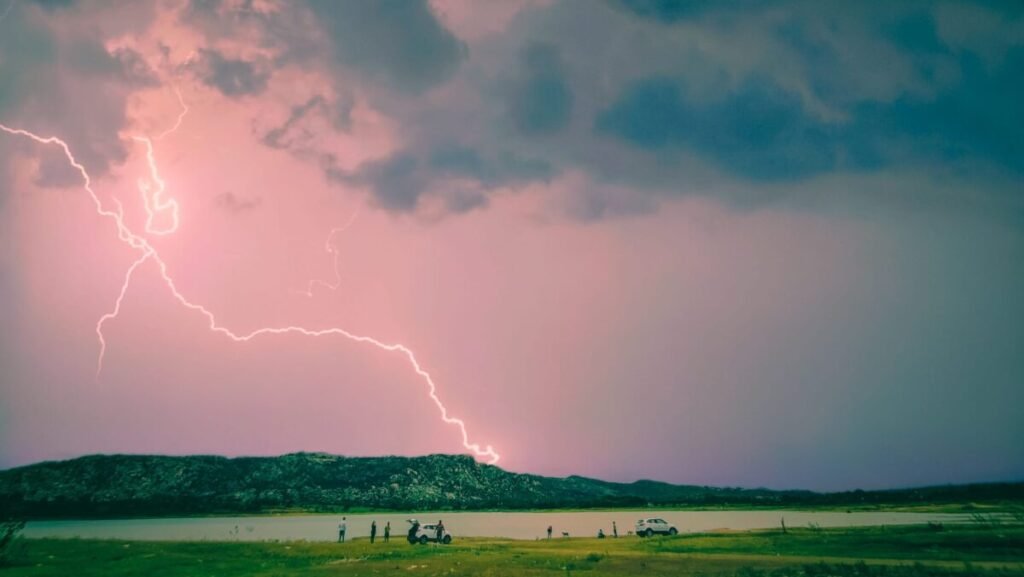
There are certain things you get used to living in Central Florida.
The afternoon sky can be bright blue one minute and nearly grey or black the next. Thunder can start rumbling before you see a drop of rain. You learn that a storm several miles away may suddenly decide your neighborhood should be its next stop.
And then there are the golfers.
I have watched a storm roll in with thunder close enough to make me uncomfortable while golfers were still standing in the middle of an otherwise empty course, clubs in hand. And your little Bella is wanting to hide under my feet.
The wind picks up. The rain starts. Thunder rolls again.
Still, there always seems to be time for just one more shot.
Maybe the storm will blow over.
Maybe they can finish the hole.
Maybe lightning has somehow agreed to wait.
It hasn’t.
What makes those scenes particularly unnerving is that this isn’t just another place that gets summer thunderstorms.
We live in Lightning Alley.
And the Name is Well Earned
The corridor from Tampa Bay to Titusville receives more lightning over the course of a year than anywhere else in the United States, with more than 90 percent of it occurring from May through October.
Central Florida happens to have just the right setup for it.
Florida is a narrow peninsula with warm water on both sides. During a hot summer day, the land heats faster than the surrounding water, and breezes begin pushing inland from both coasts.
So, the sea breeze collides with the bay breeze in a multitude of ways, and one of the results is lightning.
Exactly where those breezes meet changes with the weather, but their collision can help build the afternoon thunderstorms Central Florida is famous for.
If you live here, you don’t need a meteorology degree to know something is happening.
You can watch an ordinary summer afternoon rearrange itself.
The clouds build higher. The breeze changes. The temperature can suddenly drop.
Then comes that first distant growl.
Sometimes the entire production develops remarkably fast.
Four Corners Had an Extraordinary Year
One of the more startling measurements came from practically next door to Walt Disney World.
In 2022, Four Corners, Florida, just west of Disney’s Animal Kingdom area, recorded 1,229 lightning events per square mile.
That made Four Corners the most lightning-dense community in the United States for that year, according to Vaisala’s annual lightning report.
I like that detail because it puts Lightning Alley into perspective.
Millions of visitors arrive in Central Florida thinking about theme parks, pools, golf courses, lakes and outdoor attractions.
Meanwhile, the atmosphere is running one of the country’s busiest electrical shows overhead.
Most days, the two coexist perfectly well.
Until they don’t.
When Lightning Hits Close to Home
I learned just how serious Central Florida lightning could be when it hit close to home.
A nearby house was struck, and suddenly our normally quiet neighborhood was filled with emergency vehicles.
On a narrow little street, that becomes an event all by itself. Fire trucks take up a considerable amount of space, people want to know what happened, cars slow down to look, and before long the peaceful little street bears no resemblance to the one that was there earlier in the day.
What stayed with me was how long the firefighters remained.
A lightning strike isn’t necessarily over when the flash disappears.
Lightning can travel through a home’s electrical system and other conductive materials, creating damage that isn’t immediately obvious. Firefighters may need to check for hidden heat or signs of fire inside walls, ceilings or attic spaces before they can be sure the danger has passed.
It was one of those experiences that changes the way you hear the next thunderstorm.
Thunder stops being background noise.
At least for a while.
Hearing Thunder Is Enough
Living near a golf course provides another interesting view of Florida’s relationship with weather.
One of the easiest mistakes to make is assuming the lightning is too far away to matter.
You may not see a bolt nearby. It may not even be raining where you are.
But if you can hear thunder, lightning is close enough to be a danger.
There is frequently one last shot that absolutely must be taken before anyone admits the weather has won.
From a distance, seeing someone standing in the middle of an open green holding a golf club while thunder is sounding nearby is a little frightening.
And the important part is this: you do not have to see lightning directly overhead to be in danger.
Current safety guidance recommends if you can hear thunder, lightning is close enough to strike you. There is no safe place outdoors during a thunderstorm. The safest choices are a substantial building or a fully enclosed metal-topped vehicle.
That means a golf cart isn’t the answer.
Neither is a covered picnic pavilion.
And it sure is not a giant oak tree. Our community has easily lost more than 100 of them to storms over the years.
And neither is the very popular Florida strategy of looking at the sky and announcing, “I think it’s going the other way.”
Water Makes the Decision Easier
The same issue comes up on Florida’s lakes.
When the sky is beautiful, being out on the water is one of the great pleasures of living here.
When thunder starts, the decision should become considerably simpler.
Get off the water.
Current safety guidance recommends leaving boats and swimming areas when lightning threatens and seeking shelter in a building or vehicle. Then remain indoors until at least 30 minutes after the last thunder.
That final 30 minutes can feel excessive when the rain has stopped and blue sky has started reappearing.
It isn’t.
Lightning can occur miles from the main part of a thunderstorm, which is why the fact that the rain has ended does not automatically mean the danger has passed.
Florida storms are particularly good at creating the illusion that everything is over.
You Do Eventually Get Used to It
That’s the strange part.
When you first experience Central Florida‘s summer storms, they can seem enormous.
The sky darkens. Lightning flashes. Thunder shakes the house. Rain comes down so hard that seeing across the street can become difficult.
Then twenty or thirty minutes later, the sun may be back.
After living here awhile, you adapt.
You watch the radar before heading onto the lake. You pay more attention to the radar when you’re outside. You know an afternoon activity in July may need a Plan B.
And you become accustomed to thunder.
Perhaps a little too used to it.
Sometimes it just makes people very good at convincing themselves they have another five minutes.
Unless you’re in the pool, out boating, kayaking, or enjoying one of Florida’s other water activities.
Then those extra five minutes really aren’t worth it.
The Storms Are Part of Central Florida
Lightning isn’t something I would use to scare someone away from Central Florida.
It is simply part of living here.
So are lakes, palm trees, heat, sudden rain, spectacular clouds and summer afternoons when the sky seems determined to put on a show.
But there is a difference between getting used to something and forgetting what it can do.
Central Florida really does sit inside one of America’s great lightning hot spots.
Most days, the thunder rolls through, the rain ends and life carries on.
The golf carts come back out.
Boats return to the lake.
Someone picks up where they left off in the yard.
And by evening, the whole storm may be gone.
But when the next rumble comes, there is one Florida rule worth remembering:
If you can hear the thunder, the lightning is already close enough to matter.
Sources
- National Oceanic and Atmospheric Administration, 5 Striking Facts Versus Myths About Lightning You Should Know
- National Weather Service Melbourne, Florida Lightning Climatology
- National Weather Service, Lightning Safety Tips and Resources
- University of Florida IFAS Extension, Florida lightning safety resources
- Vaisala Xweather, 2022 Annual Lightning Report
Editorial Review
Reviewed by Claire Bennett, Managing Editor
Last reviewed: October 2026
Quick Answer Guide publishes practical, research-based answers to common questions about money, technology, health, travel, home improvement, and everyday life. Content is reviewed using official government resources, educational institutions, industry publications, and other authoritative sources when appropriate. Articles are updated periodically to improve accuracy and usefulness.