
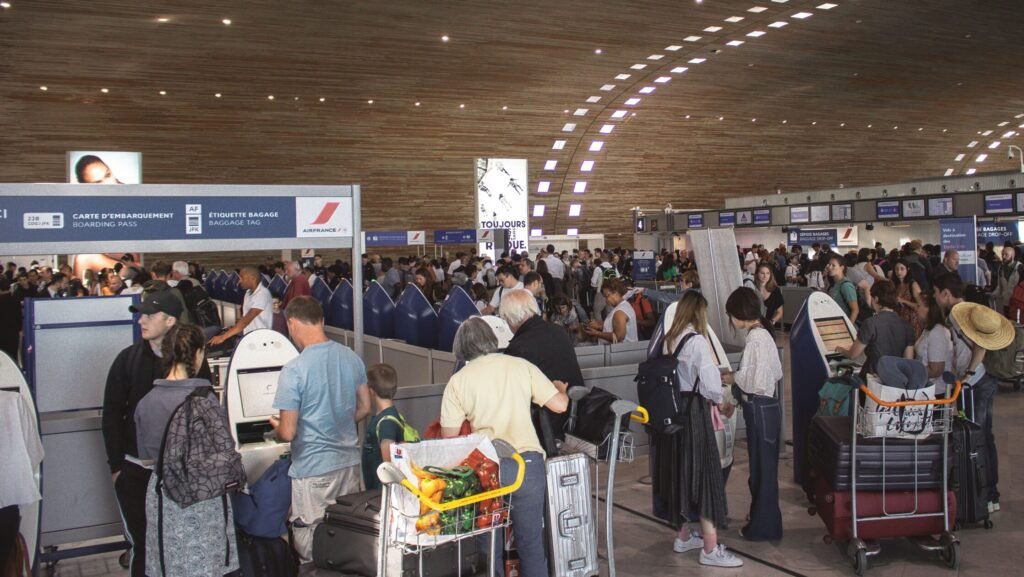
If you are arriving from an international trip, getting through “customs” usually takes 30 minutes to 2 hours from the time you leave the aircraft. A traveler who lands during a quiet period, uses an expedited program, and has no checked bag may finish sooner. A large group arriving behind several full international flights may need considerably longer.
The broad range exists because most travelers use the word customs for the entire international arrival process. That process can include walking from the aircraft, passport or immigration inspection, waiting for checked luggage, declaring goods, customs and agriculture screening, and sometimes clearing security again for a connecting flight.
The conversation with a U.S. Customs and Border Protection officer may last only a few minutes. The larger delays usually come from the passport line, baggage claim, or a secondary inspection.
For an international connection, do not plan around the fastest possible customs time. A connection that works when every step takes 15 minutes can fail when the aircraft parks late, a concourse walk takes 20 minutes, or baggage delivery slows. A realistic schedule leaves room for ordinary airport friction without turning the arrival into a sprint.
Quick Answer
For travelers entering the United States by air, practical planning ranges are:
- Very light traffic and no checked bag: about 20–40 minutes
- Typical uncomplicated arrival: about 45–90 minutes
- Busy international arrival period: about 1–2 hours
- Delayed baggage or very long lines: 2 hours or longer
- Secondary inspection: unpredictable; it may add several minutes or several hours
- U.S. preclearance airport: CBP inspection occurs before the U.S.-bound flight, so the traveler normally arrives in the United States like a domestic passenger
These ranges describe the full arrival process, not a guaranteed CBP line time. There is no single national average that accurately predicts every traveler’s experience.
CBP publishes airport wait-time information for many busy international airports. That information is useful for comparing historical processing periods, but it should not be mistaken for the total time from aircraft door to airport exit. Walking, baggage claim, customs or agriculture inspection, secondary processing, bag recheck, and another security checkpoint can add substantial time.
Typical Customs Timeline
| Arrival situation | Time to plan |
| Quiet arrival, carry-on only | 20–40 minutes |
| Average arrival with no complication | 45–90 minutes |
| Checked bag during a busy arrival bank | 60–120 minutes |
| Several large international flights arriving together | 90 minutes–2+ hours |
| Global Entry or Mobile Passport Control, carry-on only | Often faster, but not guaranteed |
| Secondary inspection | No dependable estimate |
| International arrival followed by a domestic connection | Often 2½–3½ hours of connection time is more comfortable |
| Separate-ticket international connection | Consider a larger buffer because the second airline may not protect the connection |
The connection ranges are conservative planning guidance, not official minimum connection times. An airline may sell a shorter legal connection based on the airport’s published minimum, but “sellable” and “comfortable for an occasional traveler with children and luggage” are not always the same thing.
What Does “Getting Through Customs” Actually Include?
At a traditional U.S. international arrivals facility, the trip often follows this order:
- Leave the aircraft.
- Walk to the federal inspection area.
- Join the appropriate passport-processing line.
- Complete primary inspection with CBP.
- Collect checked baggage.
- Make the required customs and agriculture declarations.
- Present bags for inspection if directed.
- Exit into the public arrivals area or recheck bags for a connection.
- Clear TSA security again when required for a connecting departure.
- Travel to the next gate.
The exact layout varies. A few facilities use a different order, and international baggage-processing programs are changing at selected airports. Follow the signs and instructions at the airport rather than trying to force every arrival into one memorized sequence.
A Realistic Time Calculation
Consider an uncomplicated arrival with one checked bag:
- Deplaning and walking to passport control: 15 minutes
- Passport line and primary inspection: 30 minutes
- Baggage claim: 25 minutes
- Declaration and customs exit: 10 minutes
15 + 30 + 25 + 10 = 80 minutes
That is one hour and 20 minutes from the aircraft to the arrivals hall.
Now add a domestic connection:
- Customs arrival process: 80 minutes
- Bag recheck: 10 minutes
- TSA screening: 30 minutes
- Walk or train to the gate: 15 minutes
- Gate buffer before boarding closes: 30 minutes
80 + 10 + 30 + 15 + 30 = 165 minutes
That equals 2 hours and 45 minutes. Nothing unusual happened in this example. The time was consumed by normal steps.
These figures are illustrations, not airport forecasts. A carry-on-only Global Entry traveler may move much faster. A family waiting for a stroller and four checked bags may need longer.
Customs vs. Immigration: What Is the Difference?
Travelers often use customs, immigration, passport control, and border control interchangeably. The terms describe different legal purposes, even when the steps occur in the same room or are handled by the same agency.
Immigration or Passport Inspection
This part focuses on the person:
- Who are you?
- What travel document are you using?
- Are you a U.S. citizen, lawful permanent resident, visitor, or another category of traveler?
- Are you permitted to enter?
- If you are a visitor, what is the purpose and expected length of the trip?
For visitors, a visa or approved ESTA authorizes travel to a U.S. port of entry but does not guarantee admission. CBP officers determine admissibility when the traveler arrives.
Customs Inspection
This part focuses on what is entering with the traveler:
- What did you buy or receive abroad?
- Are you carrying food, plants, animal products, or wildlife items?
- Are you bringing alcohol, tobacco, commercial merchandise, or restricted goods?
- Are you carrying reportable currency or monetary instruments?
- Does any item require duty, a permit, or further inspection?
Who Handles the Process in the United States?
CBP, an agency within the Department of Homeland Security, handles the inspection of people and goods at U.S. ports of entry. TSA handles security screening for departing and connecting flights. The airline handles tickets and baggage acceptance. These processes may occur close together, but they have different purposes.
ICE is not the agency operating the ordinary passport-control and customs line at a U.S. airport. Understanding that division makes airport signs and instructions less mysterious.
What Takes the Longest During Customs Processing?
Deplaning
It can take 10 to 25 minutes to leave a large aircraft, especially from a seat near the rear. A remote parking stand that requires buses can add more time.
The customs clock in your mind may begin when the aircraft lands, but the useful timing begins when the door opens—and even then, several hundred people may be ahead of you.
Walking to the Inspection Area
International arrival corridors are designed to keep arriving passengers separate from the general terminal until inspection is complete. The route can be long and may include ramps, moving walkways, escalators, or trains.
Travelers with mobility limitations should request airline assistance in advance and identify themselves to airline staff upon arrival.
Waiting for Passport Control
This is often the largest visible line. It grows when multiple wide-body aircraft arrive close together or when flight delays move several arrivals into the same period.
CBP’s Airport Wait Times tool can help travelers review processing patterns at major U.S. airports. However, a historical average cannot predict a weather disruption, staffing change, system issue, or unusually heavy group of arrivals on a particular day.
Baggage Claim
Travelers sometimes clear passport inspection quickly and then wait 30 minutes or longer for checked bags. Oversized items, strollers, wheelchairs, sports equipment, and pets may be delivered separately.
Global Entry and Mobile Passport Control can shorten passport processing, but neither makes the baggage belt move faster.
Customs and Agriculture Inspection
Most travelers move through the declaration and exit stage quickly. A question about purchases, food, plants, medication, commercial goods, or currency may require additional review.
Declare uncertain items rather than attempting to decide quietly that they “probably do not count.” An item can be admissible and still need to be declared.
Secondary Inspection
Secondary inspection is the least predictable part of the process. It may involve additional questions, record checks, document review, baggage examination, agriculture inspection, or another issue that cannot be completed in the primary line.
There is no reliable maximum time for secondary inspection. A simple clarification may be resolved quickly; a complicated immigration, identity, admissibility, enforcement, or property issue can take much longer.
What Happens at Primary Inspection?
At primary inspection, a CBP officer or approved processing system reviews the traveler’s identity and entry information. Facial-comparison technology, documents, and government records may be used as part of the process.
An officer may ask:
- Where did you travel?
- How long were you away?
- What is the purpose of your visit?
- Where will you stay?
- What items are you bringing into the country?
- Did you purchase or receive anything abroad?
- Are you carrying food, plants, or animal products?
- Are you carrying currency or monetary instruments above the reporting threshold?
Questions vary by traveler. A U.S. citizen returning from vacation, a lawful permanent resident, and a first-time foreign visitor are not being processed under identical circumstances.
Answer truthfully and directly. If you do not understand a question, ask the officer to repeat or explain it. Guessing at a question you did not understand is rarely an efficient strategy.
Keep the passport open and available, but wait for instructions before handing over additional papers. Families may be processed together when directed.
What Happens During Secondary Inspection?
Secondary inspection provides time and space for CBP to examine an issue beyond the normal primary process.
A traveler may be referred because:
- identity or travel documents need more review
- a database response requires resolution
- the officer needs additional information about the trip
- an immigration or admissibility question exists
- baggage or declarations need inspection
- food, plants, or animal products require review
- the traveler is carrying commercial goods
- a random or compliance inspection is being conducted
- an officer cannot complete the decision at primary inspection
Referral to secondary inspection does not by itself prove that the traveler committed an offense. It does mean the inspection is not finished.
During secondary:
- remain calm and follow instructions
- answer questions truthfully
- do not make jokes about weapons, drugs, undeclared goods, or false documents
- ask for clarification when you do not understand
- tell the officer about an urgent medical need
- keep travel documents organized
- do not assume a tight connection will cause the inspection to be shortened
CBP’s inspection authority at the border is broad. This article provides general travel information, not legal advice. A person with a known immigration, criminal, documentation, or admissibility concern should obtain advice from an appropriately qualified attorney before travel.
What Documents Should You Have Ready?
The required documents depend on citizenship, status, destination, and method of travel.
Common documents include:
- a valid passport
- a lawful permanent resident card, when applicable
- a visa, when required
- an approved electronic travel authorization, when required
- supporting documents for the traveler’s immigration category
- receipts for high-value purchases
- permits or certificates for restricted items
- information about food, plants, medication, or commercial merchandise
U.S. citizens returning by international air generally need a valid U.S. passport book. Different documents may be accepted for certain land and sea travel.
Keep important documents in carry-on baggage, not in a checked suitcase. A passport packed beneath the aircraft is an impressive example of security that has become inconvenient.
For Families
Before landing:
- place all family passports together in a secure document holder
- confirm that each child’s passport is present
- complete declarations for the household as directed
- make a short list of purchases and food items
- explain to children that the family must stay together
- locate baggage claim tags
One adult can manage documents while another watches the children and carry-ons. Switch responsibilities if the document-holding adult also needs to retrieve several suitcases.
What Must Be Declared When Entering the United States?
Customs rules are detailed, but the safest principle is simple: declare what the question asks, and ask about anything uncertain.
Travelers commonly need to report:
- merchandise purchased abroad
- gifts received abroad
- items bought for other people
- food and agricultural products
- plants, seeds, soil, meat, and animal products
- alcohol and tobacco
- commercial samples or goods for resale
- repairs or alterations performed abroad
- certain restricted or controlled items
- currency or monetary instruments above the reporting threshold
“Duty-free” does not mean “declaration-free.” It describes how an item was sold, not whether the traveler must tell CBP about it.
Food and Agricultural Items
CBP instructs travelers to declare agricultural items. The rule covers items in checked baggage, carry-on baggage, and vehicles.
Some products are allowed, some require inspection or documentation, and some are prohibited because they can carry plant pests or animal diseases. Packaged food can still be an agricultural item. When in doubt, declare it and let the officer or agriculture specialist make the decision.
Currency and Monetary Instruments
Carrying a large amount of money is not automatically illegal. Federal law requires reporting when a traveler enters or leaves the United States with more than $10,000 in currency or certain monetary instruments, measured in U.S. dollars or the foreign equivalent.
The reporting rules can apply to combinations of monetary instruments and people traveling together. Because the details matter, review CBP and FinCEN instructions before traveling with a large amount rather than relying on a simplified airport explanation.
Purchases and Gifts
Keep a basic list and receipts. CBP requires travelers to declare items acquired abroad, including gifts. Whether duty is owed depends on the item, value, trip, personal exemption, and other rules.
Being over an exemption does not automatically mean the item is prohibited. It may mean duty must be calculated.
How Global Entry Can Reduce Customs Time
Global Entry is a CBP Trusted Traveler Program that provides expedited U.S. entry processing for preapproved, low-risk travelers.
Depending on the airport and current technology, eligible members may use:
- Global Entry portals
- facial-comparison processing
- designated lanes
- the Global Entry mobile application at participating locations
Global Entry often reduces the passport-processing portion of arrival. It does not guarantee that:
- the traveler will never wait
- baggage will arrive sooner
- customs declarations can be ignored
- an inspection cannot occur
- a connecting-flight security line will be shorter
Members remain subject to inspection and must follow declaration requirements. Violations can affect membership.
Global Entry is most useful for travelers who enter the United States repeatedly. Someone taking fewer international trips may prefer to check whether the free Mobile Passport Control option meets their needs.
How Mobile Passport Control Can Help
Mobile Passport Control, commonly called MPC, is a free CBP application for eligible travelers at participating locations. It allows travelers to submit travel-document information, a photograph, and declaration information through the app, then present the resulting submission during entry processing.
As of this July 2026 review, eligible groups include U.S. citizens, U.S. lawful permanent residents, certain Canadian visitors, and certain returning Visa Waiver Program travelers. Eligibility and participating locations can change, so travelers should verify the current CBP list.
MPC does not require the same advance application, background vetting, interview, or fee as Global Entry. It can reduce time by directing eligible users to the appropriate processing area, but it does not guarantee immediate entry or exemption from inspection.
Before travel:
- Download only the official CBP MPC application.
- Create traveler profiles before the trip.
- Confirm that the arrival location participates.
- Submit the trip information when permitted.
- Follow airport signs for the MPC process.
Do not confuse Mobile Passport Control with a passport. The app is a processing tool; the traveler must still carry the required physical travel document.
How U.S. Preclearance Changes the Arrival
At designated foreign airports, CBP performs U.S. immigration, customs, and agriculture inspection before travelers board their U.S.-bound flight. This is called preclearance.
After preclearance, the flight normally arrives at a domestic gate in the United States. Travelers generally collect their baggage and leave or connect without visiting a regular CBP arrivals hall again.
This can make the U.S. arrival much faster, but the time has not disappeared—it moved to the departure airport abroad. Travelers using preclearance should arrive early enough to complete airline check-in, local security, and CBP processing before boarding.
If the itinerary begins at a preclearance airport, follow that airport and airline’s recommended arrival time. A traveler who plans around an ordinary domestic departure schedule may not leave enough time.
What If You Have a Connecting Flight?
Connections after international arrival require more planning than ordinary domestic connections.
Entering the United States at the First U.S. Airport
Travelers arriving from overseas generally clear CBP at the first U.S. port of entry. Checked luggage normally must be collected and presented through CBP, even if the airline tagged it to the final destination.
After customs, connecting passengers usually place already-tagged bags onto a recheck belt or take them to an airline recheck point. They may then need to clear TSA security before going to the next gate.
Exceptions exist. Precleared flights arrive differently, and CBP and airlines have introduced limited baggage-screening arrangements that may allow some connecting bags to continue without the traditional pickup. Follow the instructions for the specific flight and airport. Never walk away from baggage claim merely because the tag shows the final city.
How Long Should the Connection Be?
There is no universal safe connection time.
For an uncomplicated arrival on one ticket:
- About 2 hours: possible at some airports, but vulnerable to ordinary delays
- About 2½ to 3 hours: more comfortable for many travelers
- About 3 to 4 hours: sensible for large airports, checked bags, children, limited mobility, peak periods, or unfamiliar travelers
- Longer: appropriate when separate tickets, terminal changes, visa issues, or high consequences are involved
The airline’s reservation system may offer a shorter connection that meets the airport’s formal minimum. That does not guarantee that every traveler will make it.
One Ticket vs. Separate Tickets
On one through-ticket, the airline may rebook a passenger who misses a protected connection because the inbound flight was late or processing took too long, subject to the ticket and airline rules. Do not assume that meals, lodging, or every related expense will be covered.
With separate tickets, the second airline may treat the missed departure as a no-show. The traveler may also need to move and recheck baggage at the normal departure counter before its cutoff. Separate-ticket connections deserve a much larger buffer.
If a connection is missed, complete CBP processing first, retrieve the bags as directed, and then contact the airline. A missed flight does not cancel the legal requirement to finish inspection.
What Affects Customs Processing Time?
Number and Timing of Arrivals
Two international flights landing ten minutes apart may place hundreds of travelers into the same facility. Delayed flights can create an arrival surge outside the normal schedule.
Citizenship and Processing Lane
U.S. citizens, lawful permanent residents, visitors, Global Entry members, MPC users, flight crews, and other groups may use different processing methods or lines.
Choose the lane indicated by signs and officers. Moving to a shorter but incorrect line usually saves no time.
Airport Layout
Walking distance, buses, baggage placement, recheck areas, terminal trains, and checkpoint locations affect the total arrival time even when the CBP line is short.
Checked Baggage
A carry-on-only traveler can move toward the customs exit after primary inspection. A traveler with checked baggage must wait for every required bag or report a missing one before continuing.
Documentation
An expired document, damaged passport, name discrepancy, missing visa, uncertain status, or incomplete information can lead to more review.
Declarations
Food, agricultural goods, high-value purchases, commercial items, restricted articles, and reportable currency may require questions, forms, duty calculation, or inspection.
Secondary Inspection
Secondary processing has no dependable duration and can turn a short arrival into a lengthy one.
Technology and Staffing
System interruptions and available processing capacity can affect lines. Travelers cannot control these factors, which is one reason a connection buffer matters.
Ways to Get Through Customs More Smoothly
Before the Trip
- Check passport validity and entry documents.
- Review the destination’s rules before departing and U.S. rules before returning.
- Keep receipts for purchases.
- Make a list of food, gifts, and merchandise.
- Verify Global Entry membership details or MPC eligibility.
- Review the connection airport’s international-arrival instructions.
- Avoid a short separate-ticket connection.
Before Landing
- Place passports and residency documents where they are easy to reach.
- Complete required electronic or paper declarations.
- Add up purchases rather than trying to remember totals at the counter.
- Tell family members what happens after landing.
- Check the next flight and gate without assuming it remained unchanged.
During Processing
- Use the correct line.
- Keep the family and carry-ons together.
- Answer questions truthfully and briefly.
- Declare uncertain items.
- Follow directions about photographs and phone use in the inspection area.
- Have receipts accessible but present them only when requested.
- Ask for clarification rather than guessing.
After Passport Inspection
- Check the baggage carousel number.
- Count every bag before leaving the claim area.
- Follow signs for declarations and connections.
- Recheck connecting bags where directed.
- Confirm whether TSA screening is required.
- Recheck the departure gate and boarding time.
The goal is not to appear as though you have memorized federal procedure. The goal is to be prepared, truthful, and easy to process.
Traveling With Young Children
An international arrival can be tiring for children who have already been confined to an aircraft for hours.
To make the process easier:
- use the restroom before joining a long line when practical
- keep simple snacks and permitted drinks accessible
- give older children one clear job, such as holding a jacket
- keep passports with one adult
- have another adult manage luggage and strollers
- count bags and children before leaving each area
- explain that officers may ask adults questions
- do not let children open food packed for declaration while in line
Children may become noisy or restless. That is not a customs violation. Keep them close, follow instructions, and focus on one step at a time.
Arriving During a Family Emergency or After a Loss
Travelers returning after an illness, death, or family emergency may be exhausted and distracted. A simple written list can prevent avoidable problems:
- passports
- residency documents
- medications
- purchase and gift list
- food or agricultural items
- checked-bag count
- connecting flight and gate
- family contact after arrival
Inherited belongings and gifts acquired abroad may still need to be declared. Special items such as cremated remains, medications, cultural property, or animal products can have airline, TSA, customs, or destination rules beyond the normal arrival process. Research those before travel and carry supporting documentation when required.
If you become overwhelmed at the inspection point, pause, listen to the question, and answer what was asked. You do not need to deliver the entire story of the trip unless the officer requests it.
Customs at Airports Outside the United States
The basic pattern—passport control, baggage, declaration, and inspection—is common, but procedures vary by country.
Differences may include:
- electronic arrival cards
- separate health or agriculture screening
- red and green customs channels
- visas issued or verified on arrival
- exit immigration controls
- proof of onward travel
- local duty-free allowances
- restrictions on medication, food, electronics, or cultural items
Do not assume U.S. rules apply abroad. Use the destination government’s official immigration and customs websites. Airline summaries can help identify a requirement, but the destination authority is the controlling source.
At some airports, customs is nearly invisible for travelers with nothing to declare. At others, every arriving passenger follows a formal inspection path.
Customs at Land Borders and Cruise Ports
The 30-minute-to-2-hour air-arrival estimate should not be applied automatically to cars, buses, trains, or cruise ships.
Land Borders
Vehicle wait times depend on the port, lane type, day, season, and nearby events. CBP publishes separate land-border wait information. The vehicle queue is only part of the process; secondary inspection can add time.
Cruise Ports
Cruise processing depends on ship size, arrival clearance, passenger group, luggage procedures, and port operations. A passenger’s scheduled walk-off or luggage group can matter as much as the CBP interaction.
Do not schedule a flight solely around the cruise line’s earliest theoretical disembarkation. Allow time for ship clearance, leaving the vessel, finding baggage, inspection, ground transportation, airport check-in, and TSA screening.
Why Customs Sometimes Takes Several Hours
Long processing can result from:
- multiple delayed flights arriving together
- weather or airport disruptions
- system outages
- long passport-control lines
- delayed baggage
- a missing suitcase report
- agriculture or commercial-goods inspection
- document or identity questions
- immigration or admissibility review
- secondary inspection
- a large family or tour group
- terminal transfers after customs
The traveler can reduce preventable delays but cannot control the entire system. This is why a good connection plan includes a buffer instead of assuming the fastest previous experience will repeat.
Related Articles
If you are preparing for international travel, these related guides may also help:
- How Long Does It Take to Get a Passport?
- How Long Does It Take to Get a Visa?
- How Long Does It Take to Get Travel Insurance?
- How Long Does It Take to Get Through Airport Security?
- How Long Does It Take to Check In For a Flight?
Frequently Asked Questions
How long does it take to get through customs after an international flight?
Plan about 45 to 90 minutes for an uncomplicated U.S. arrival. A quiet carry-on-only arrival may take 20 to 40 minutes, while busy periods, baggage delays, or additional inspection can extend the process beyond two hours.
Is 30 minutes enough to get through customs?
It is possible under favorable conditions but should not be used to plan an important connection. Deplaning, walking, passport processing, baggage, and customs can easily take longer.
Can customs take several hours?
Yes. Heavy arrival volume, delayed baggage, document issues, agriculture review, system problems, or secondary inspection can extend processing for several hours.
What documents do U.S. citizens need when returning by air?
U.S. citizens generally need a valid U.S. passport book for international air travel. Requirements differ for some land and sea travel. Check current State Department and CBP guidance.
What documents do foreign visitors need?
Requirements depend on nationality and travel category. A visitor may need a valid passport, visa or ESTA, and supporting travel information. A visa or ESTA does not guarantee admission; CBP determines admissibility at the port of entry.
What is the difference between customs and immigration?
Immigration or passport inspection concerns the traveler’s identity and permission to enter. Customs concerns goods, declarations, duty, agriculture, and restricted items. CBP handles both functions at U.S. ports of entry.
Do I collect my checked bag before customs?
Usually yes when entering the United States through a traditional international arrivals facility. Connecting travelers generally retrieve checked bags and present them through CBP at the first U.S. entry point, then recheck them. Preclearance and certain airport programs are exceptions, so follow local instructions.
Do I have to go through customs on a connecting flight?
When the connection is at the first U.S. airport after an overseas departure, travelers generally clear CBP there. They may also need to retrieve and recheck baggage and clear TSA security. A connection after U.S. preclearance is normally treated differently.
Is a two-hour international connection enough?
It can be enough at some airports under favorable conditions, especially with carry-on baggage and expedited processing. It can also be too short after a late arrival, baggage delay, long CBP line, or terminal change. Two and a half to three hours is more comfortable for many travelers, with more time for families, separate tickets, or complicated airports.
Does Global Entry guarantee fast customs processing?
No. Global Entry usually expedites entry processing for approved members, but members remain subject to inspection. It does not control baggage delivery, TSA connection lines, or flight delays.
Is Mobile Passport Control the same as Global Entry?
No. MPC is a free application for eligible travelers at participating locations and does not use the same advance vetting and interview process. Global Entry is a paid Trusted Traveler Program for preapproved members.
Can families use Mobile Passport Control together?
Eligible family members may be included according to the current app instructions. Every traveler must meet the eligibility requirements and possess the required travel document.
What happens during secondary inspection?
CBP may ask more questions, review documents or records, inspect baggage, or resolve an immigration, customs, agriculture, identity, or enforcement issue. The duration is unpredictable, and referral does not by itself establish wrongdoing.
Can CBP inspect luggage?
Yes. Travelers and their belongings are subject to inspection at the U.S. port of entry. Checked and carry-on bags may be examined.
Do I need to declare packaged food?
Agricultural items must be declared, and packaged food can still fall within that category. Declare it and allow CBP or an agriculture specialist to determine whether it is admissible.
Do duty-free purchases have to be declared?
Yes. “Duty-free” does not remove the declaration requirement. Whether duty is actually owed is a separate determination.
Is it illegal to carry more than $10,000?
No, carrying more than $10,000 is not automatically illegal. Federal law requires reporting when entering or leaving the United States with more than $10,000 in currency or covered monetary instruments. Review the official requirements because aggregation rules can apply.
Is customs faster at a small airport?
Sometimes, because fewer international passengers may arrive. However, smaller facilities may have fewer processing resources or limited arrival schedules. Airport size alone does not predict the wait.
Does every traveler fill out a paper customs form?
Not necessarily. Declaration information may be collected on paper, through an app, electronically, or through questions during processing, depending on the airport and traveler program. Every traveler remains responsible for making accurate declarations.
Can customs make me miss my connection?
Yes. CBP processing, baggage claim, bag recheck, TSA screening, and terminal travel can exceed the connection time. Book a realistic connection and understand the airline’s rebooking terms.
What happens after U.S. preclearance?
The traveler completes CBP inspection at the foreign departure airport. The flight normally arrives at a domestic gate in the United States, allowing the traveler to collect baggage and exit or connect without another routine CBP inspection.
Quick Summary
Getting through U.S. customs generally takes 30 minutes to 2 hours from aircraft exit, with about 45 to 90 minutes being a useful planning range for an uncomplicated arrival. The complete process may include walking, passport inspection, baggage claim, declarations, customs or agriculture screening, and additional steps for a connection.
Global Entry and Mobile Passport Control can reduce the passport-processing portion for eligible travelers, but neither guarantees immediate entry or faster baggage. Secondary inspection has no reliable time estimate.
Travelers connecting at their first U.S. airport generally clear CBP there, retrieve checked bags, recheck them, and pass through TSA screening before reaching the next gate. Preclearance flights and certain baggage programs can work differently.
The best preparation is straightforward: carry the correct documents, keep a list of purchases and food, make truthful declarations, check the airport and airline connection instructions, and leave a reasonable time buffer. International arrivals are easier when you understand the sequence, even when you cannot control the line.
Sources & References
- U.S. Customs and Border Protection — Airport Wait Times
- U.S. Customs and Border Protection — What to Expect When You Return
- U.S. Customs and Border Protection — Checking Baggage Through to a Final Destination
- U.S. Customs and Border Protection — Mobile Passport Control
- U.S. Customs and Border Protection — Global Entry
- U.S. Customs and Border Protection — Preclearance
- U.S. Customs and Border Protection — Admission Into the United States
- U.S. Customs and Border Protection — Bringing Agricultural Products Into the United States
- U.S. Customs and Border Protection — Money and Other Monetary Instruments
- U.S. Customs and Border Protection — Shopping Abroad: Duty Free, Gifts, and Household Items
- Official customs, immigration, and airport-arrival instructions published by the traveler’s destination country
Editorial Review
Reviewed by Claire Bennett, Managing Editor
Last reviewed: July 2026
Quick Answer Guide publishes practical, research-based answers to common questions about money, technology, health, travel, home improvement, and everyday life. Content is reviewed using official government resources, educational institutions, industry publications, carrier documentation, and other authoritative sources when appropriate. Articles are updated periodically to improve accuracy and usefulness.
