
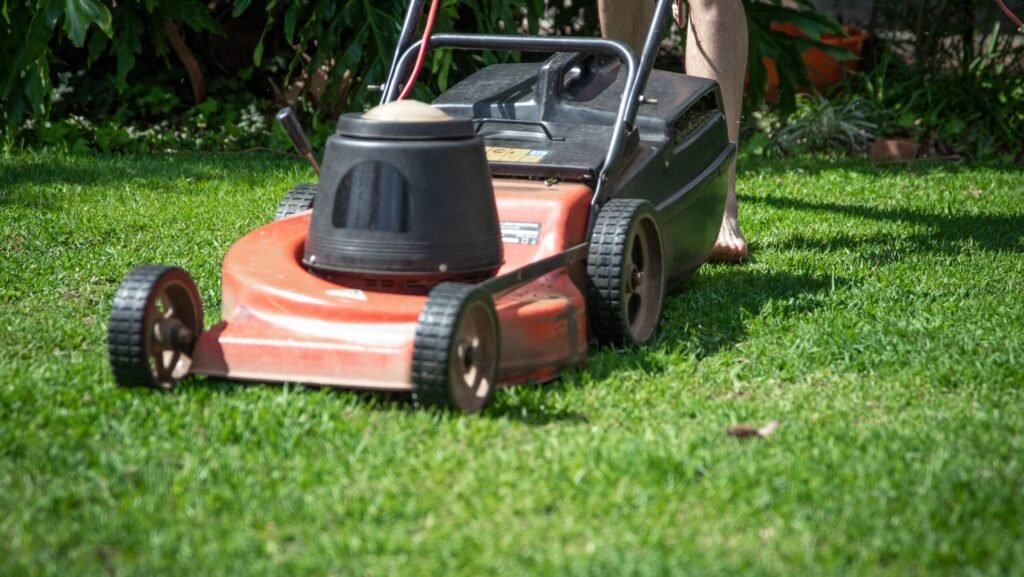
Two lawns can be exactly the same size and take completely different amounts of time to mow.
One might be a big open rectangle where you can make long passes from one end to the other. The other might have trees, flower beds, fences, gates, a pool, a slope, and enough little corners to make you wonder whether the person who designed the landscaping had a personal grudge against lawn mowers.
Then there is the mower itself.
A riding mower can make quick work of a large open lawn, while a push mower takes considerably longer. But put that riding mower in a small yard with tight turns and narrow gates, and suddenly bigger isn’t necessarily faster.
For most residential lawns, mowing takes anywhere from about 15 minutes to 2 hours. Larger properties can take several hours, especially when trimming, edging, bagging, and cleanup are included.
Quick Answer
Most residential lawns take about 15 minutes to 2 hours to mow. Small lawns may take less than 30 minutes, while larger properties can require several hours depending on lawn size, mower type, slopes, obstacles, trimming, edging, and cleanup.
Typical Lawn-Mowing Times
A reasonable starting point looks something like this:
| Mowable Lawn Area | Typical Mowing Time |
| Less than 1/4 acre | 15–30 minutes |
| 1/4 to 1/2 acre | 30–60 minutes |
| 1/2 to 1 acre | 30 minutes–2 hours |
| More than 1 acre | 1–3 hours or longer |
These are estimates, not stopwatch rules.
A flat acre with few obstacles and a wide riding mower can be cut much faster than a smaller lawn with slopes, trees, landscaping, fences, and a walk-behind mower.
And here’s an important distinction: measure the lawn, not the property.
A half-acre lot doesn’t necessarily contain half an acre of grass. The house, driveway, patio, pool, planting beds, and other areas all reduce the amount that actually needs mowing.
Why Does One Lawn Take So Much Longer Than Another?
Square footage is only the beginning.
The Mower Makes a Big Difference
For a small lawn, a push or self-propelled mower may be exactly what you need. It’s easy to maneuver around landscaping and into tight spaces.
As the lawn gets larger, a riding mower can save a considerable amount of time and physical effort.
A zero-turn mower can be even quicker on a large property because it can maneuver closely around trees, beds, and other obstacles.
But there is a catch.
A huge mower doesn’t help much if it won’t fit through the gate.
The fastest mower is usually the one that matches the property, not simply the one with the biggest cutting deck.
Trees, Flower Beds and Fences Add Time
Every obstacle interrupts those nice, straight mowing passes.
Trees require turns. Flower beds require careful edges. Fences create narrow strips. Gates have to be navigated. Retaining walls, utility boxes, landscape lights, play equipment, and decorative features all add little pockets of time.
One or two don’t matter much.
Put enough of them together and the trimming can take almost as long as the mowing.
Slopes Change Everything
A flat lawn is generally faster and easier to mow than a yard with hills, drainage ditches, terraces, or rough ground.
Slopes also introduce a safety issue.
Not every riding or zero-turn mower is designed for the same degree of slope, particularly when the grass is wet.
The mower manufacturer’s operating and slope instructions should always take priority over speed.
Tall Grass Turns a Simple Job Into a Bigger One
Miss a mowing during a period of fast growth and you’ll probably notice the difference the next time.
Tall, thick grass can slow the mower, clog the deck, and leave clumps behind.
You may need to raise the cutting height or make another pass later.
And mowing it extra short to “catch up” isn’t a great solution.
A commonly used guideline is the one-third rule: avoid removing more than about one-third of the grass blade in a single mowing.
For example, if you’re maintaining the lawn at 3 inches, you would normally mow when it reaches roughly 4½ inches rather than allowing it to become much taller and then chopping it back to 3 inches all at once.
The proper mowing height varies by grass species, so that 3-inch example isn’t a recommendation for every lawn.
The bigger point is simple: mow according to how fast the grass is growing, not just because Saturday arrived.
Wet Grass Is a Time Thief
If you’ve ever tried mowing wet grass, you probably don’t need much convincing here.
Wet grass is heavier.
It can stick beneath the mower deck, form clumps, produce a less even cut, and force you to stop and clear the machine more frequently.
Wet soil creates its own problems, including ruts and poor traction.
Waiting until the grass has dried usually makes the job both easier and faster.
That’s also why early morning isn’t automatically the best time to mow. If the lawn is still covered in dew, waiting until later in the morning may give you much better conditions.
Mowing Isn’t Always the Part That Takes the Longest
Ask someone how long it takes to mow their lawn and they may tell you 45 minutes.
Then watch the entire job.
They move the hose. Pick up branches.
Mow for 45 minutes. Get out the string trimmer.
Trim around the fence and trees. Edge the driveway.
Blow grass off the sidewalk.
Put everything away.
Suddenly the 45-minute lawn took an hour and a half.
The extra jobs commonly include:
- Moving hoses, toys, furniture, branches, and pet items
- String trimming around trees, fences, and landscaping
- Edging sidewalks and driveways
- Emptying grass bags
- Blowing clippings from hard surfaces
- Cleaning or putting away equipment
So when you’re estimating how much of your afternoon the lawn will consume, decide whether you mean mowing or the entire lawn-mowing routine.
Those aren’t always the same thing.
Bagging, Mulching or Side Discharge?
How you handle the clippings can change the timeline too.
Bagging
Bagging generally takes the longest because you have to stop and empty the collection system.
There are times when collecting clippings makes sense, but if speed is the goal, those repeated stops add up.
Mulching
A mulching mower chops the clippings into smaller pieces and returns them to the lawn.
When grass is dry and mowed regularly, those small clippings can settle into the turf and decompose rather than needing to be collected.
That eliminates the repeated trips to empty a bag.
Side Discharge
Side discharge can also be quick because the mower doesn’t have to stop for collection.
However, tall or heavy grass may leave visible rows or clumps that require additional cleanup.
Whichever method you use, clippings shouldn’t be discharged toward people, pets, vehicles, windows, streets, or neighboring property.
How to Get the Lawn Done Faster Without Butchering It
There are a few genuinely useful ways to save time.
Clear the lawn first. Walking around and picking up branches, toys, hoses, rocks, and other objects before starting is faster than stopping the mower every few minutes.
Use a sharp blade. A dull blade tears rather than cuts cleanly and can leave ragged, discolored grass tips.
Use long, efficient passes. Randomly zigzagging around the yard usually means covering the same ground unnecessarily.
Mow when the grass is dry. Dry grass generally moves through the mower more easily and leaves fewer clumps.
Keep up with it during fast growth. Regular mowing is normally much easier than trying to reclaim an overgrown lawn.
Match the mower to the yard. A wide riding mower can save enormous amounts of time on open ground. A smaller mower may actually be quicker when the property is full of narrow spaces.
And maintain the mower. Discovering a flat tire, dead battery, empty fuel tank, or other problem after you’ve already changed clothes and marched outside isn’t technically mowing time, but it certainly feels like it.
What About Robotic Mowers?
Robotic mowers make the question “How long does it take to mow?” a little strange.
The machine itself may spend hours moving around the lawn in frequent, overlapping cycles.
But the homeowner isn’t walking behind it.
So the actual cutting time may be longer while the human time involved can be much shorter.
Robotic mowers aren’t suitable for every property.
Their effectiveness depends on the lawn size, slopes, boundaries, obstacles, and capabilities of the particular model.
Still, they’re a good reminder that mowing time and your mowing time aren’t necessarily the same thing anymore.
How Often Should You Mow?
There isn’t one nationwide answer.
Grass grows at different rates depending on species, temperature, rainfall, irrigation, fertilizer, season, and climate.
Cool-season grasses often grow most actively during spring and fall. Warm-season grasses generally grow faster during warm weather and slow down as temperatures fall.
Even the same lawn may need mowing frequently during one part of the year and barely at all during another.
Instead of automatically mowing every seven days, watch the height of the grass and use the one-third guideline.
The lawn doesn’t own a calendar.
Is Hiring a Lawn Service Faster?
Almost certainly, at least in terms of the time you spend doing it.
Professional lawn crews often use commercial equipment and divide the work among several people. One person may mow while another trims and edges.
That can make a job that takes a homeowner a couple of hours look suspiciously easy.
If you’re comparing lawn services, find out exactly what the quoted visit includes. “Mowing” may or may not include trimming, edging, blowing hard surfaces, bagging, gates, steep areas, or removing clippings.
Related Articles
Planning more work around the yard? These related guides can help you estimate the time required for other gardening and outdoor projects:
- How Long Does It Take Tomatoes to Grow?
- How Long Does It Take Flowers to Bloom?
- How Long Does It Take to Build a Deck?
- How Long Does It Take Orchids to Bloom?
- How Long Does It Take to Install a Fence?
Frequently Asked Questions
Does wet grass take longer to mow?
Usually. Wet grass is heavier, more likely to clog the mower, and more likely to leave clumps. Wet soil can also reduce traction and leave wheel ruts.
Does a riding mower save time?
Generally, yes, particularly on larger and more open lawns. On a small property with narrow gates and numerous obstacles, the advantage may be much smaller.
Does bagging add time?
Yes. Bagging requires stopping to empty the collection system, so mulching or side discharge is often faster when conditions are suitable.
Should an overgrown lawn be mowed twice?
An extremely overgrown lawn may need to be returned to its normal height gradually. Start with a higher mower setting rather than removing too much of the grass blade at once.
Does “mowing the lawn” include trimming and edging?
Not necessarily. If you’re estimating your own time or hiring a lawn service, find out whether mowing, trimming, edging, blowing, and clipping removal are being counted separately.
Quick Summary
Most residential lawns take somewhere between 15 minutes and 2 hours to mow, while properties larger than an acre may take 1 to 3 hours or more.
But acreage alone doesn’t tell the whole story.
Mower type, grass height, moisture, slopes, fences, trees, flower beds, gates, bagging, trimming, edging, and cleanup can change the timeline dramatically.
A large open lawn with the right mower may actually be quicker than a much smaller but complicated yard.
And if you want to keep mowing time under control, one of the simplest tricks is also the least exciting: don’t let the grass get wildly ahead of you in the first place.
Sources & References
- Iowa State University Extension — Proper Mowing of the Home Lawn
- University of Florida IFAS Extension — Weed Management Guide for Florida Lawns
- University of Minnesota Extension — Lawn Care Calendar
- Penn State Extension — The Impact of Mowing on Weed Pressure
- Colorado State University Extension — Turfgrass Management
- Purdue University Extension — Building and Maintaining Turfgrass Fields
- U.S. Environmental Protection Agency — Recycling Grass Clippings
Editorial Review
Reviewed by Claire Bennett, Managing Editor
Last reviewed: October 2026
Quick Answer Guide publishes practical, research-based information designed to help readers understand everyday timelines and make informed decisions. Articles are developed using authoritative sources, including government agencies, universities, Cooperative Extension programs, professional organizations, and recognized industry publications.
Lawn-mowing times are general estimates. Lawn size, property layout, grass species and condition, terrain, equipment, weather, and the amount of trimming and cleanup can substantially affect individual results.