
Florida’s Birds Don’t Wait for You to Go Looking for Them
Florida is home to some extraordinary birds — and you don’t need a wildlife sanctuary to see them. Sometimes they’re standing in your front yard, fishing along the edge of a lake, soaring overhead while you’re enjoying an afternoon outdoors… or blocking traffic.
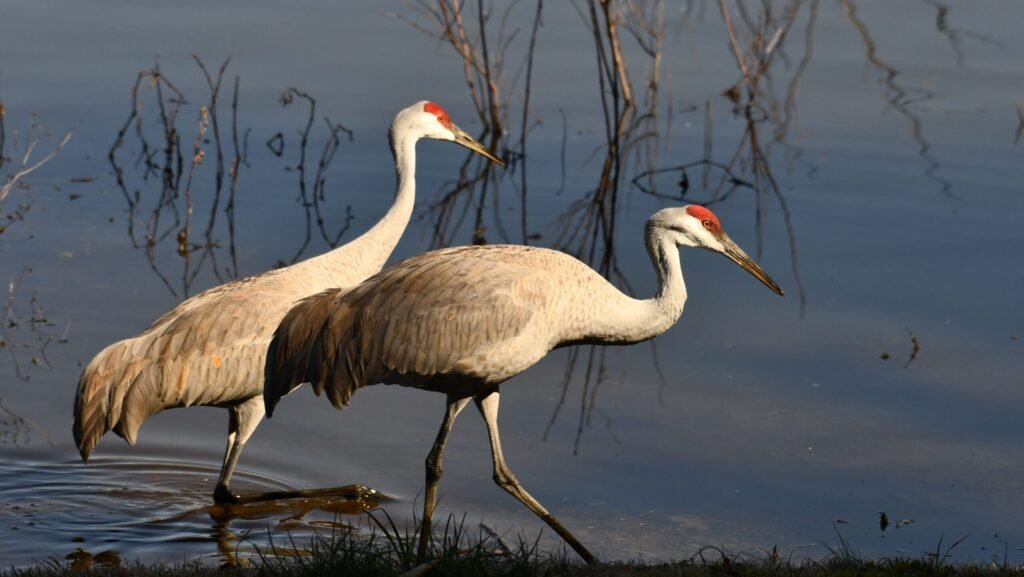
In many Florida neighborhoods, stopping for a family of sandhill cranes is simply part of everyday life. These tall, long‑legged birds wander across streets, stroll through yards, and explore golf courses as though they own the place.
Then there are the ospreys perched high above the lakes, the unusual snakebirds swimming through the canals, and the colorful wading birds that make Florida’s waterways so interesting.
And of course, there’s the flamingo — the famous pink bird practically synonymous with the Sunshine State.
Each has its own personality, unusual habits, and unforgettable story.
Sandhill Cranes: Florida’s Unofficial Neighborhood Residents
Imagine driving through a quiet Florida neighborhood when traffic suddenly comes to a stop. There’s no accident, no construction, no traffic signal.
Just two sandhill cranes crossing the road.
And they’re certainly not in a hurry.
One might pause halfway across to inspect something in the grass while the other leisurely continues toward the opposite side. Meanwhile, everyone waits. There’s really nothing else to do — cranes have their own schedule, and it rarely aligns with yours.
In some communities, sandhill cranes are so common they almost feel like neighborhood pets. They wander through yards, stroll along sidewalks, and search for food among the grass. Golf courses are especially appealing thanks to their open spaces and abundant insects.
Standing nearly four feet tall, with long legs, gray feathers, and distinctive red patches on their heads, cranes are impossible to mistake for anything else. And they aren’t shy about making themselves heard — their loud, rattling calls can travel remarkable distances.
But one of the most remarkable things about sandhill cranes is the relationship they share with their mates.
A Partnership That Can Last a Lifetime
Sandhill cranes usually mate for life. Once two cranes form a pair, they may remain together for many years — traveling, nesting, and raising their young as partners.
That’s why you often see them walking together, sometimes with one or two youngsters following close behind.
Their chicks, called colts, hatch covered in soft, rusty‑colored down. They can walk shortly after emerging from their eggs and soon begin exploring the world under their parents’ watchful care.
Young cranes remain with their parents for months, learning how to find food and navigate their surroundings. Eventually, they become independent and begin looking for partners of their own.
If an adult crane loses its mate, it may eventually form a new pair bond. Lifelong partnerships are common, but not absolute.
And then there’s the part of crane relationships that’s impossible to forget:
Their dancing.
When Sandhill Cranes Put on a Show
If you’ve ever witnessed sandhill cranes performing their courtship dance, you probably haven’t forgotten it.
These ordinarily graceful birds suddenly become enthusiastic performers. They stretch their wings, leap into the air, bow toward one another, and sometimes toss bits of grass into the air. Their movements can be surprisingly energetic for such large birds.
And the performance isn’t quiet.
Their loud, trumpeting calls seem to announce their excitement to the entire neighborhood.
There’s something magnificent about watching a pair of cranes jumping and dancing together. And their dancing isn’t limited to courtship — established pairs also perform displays to strengthen their bonds. Even younger cranes sometimes dance.
One minute they’re quietly searching for insects in someone’s front yard. The next, they’re putting on a performance worthy of an audience.
If you’re lucky enough to be nearby when it happens, it’s a wonderful little piece of Florida wildlife to experience.
Enjoy Them — But Please Don’t Feed Them
Because sandhill cranes are so comfortable wandering through residential neighborhoods, it’s easy to forget they’re wild animals.
Occasionally, someone decides to put out food for them. It may seem friendly, but feeding sandhill cranes is actually illegal in Florida.
When cranes become accustomed to receiving food from people, they may begin expecting it. Some lose their natural caution and can become demanding or even aggressive.
Fortunately, getting along with cranes is simple: Let them find their own food, give them space, and enjoy watching them.
You go about your business, they go about theirs — and everyone gets along just fine.
Just be prepared to wait when they decide it’s time to cross the street.
The Osprey: Florida’s Remarkable Fisherman
While sandhill cranes spend much of their time on the ground, another impressive Florida bird prefers a much higher view: the osprey.
Travel along almost any large Florida lake or coastal waterway, and you’ll likely spot one. Ospreys are magnificent birds of prey with broad wings, brown‑and‑white feathers, and a distinctive dark stripe through each eye.
They’re sometimes called fish hawks — and for good reason. Fish make up nearly their entire diet.
An osprey may circle high above a lake, scanning the water below. When it spots a fish near the surface, it can suddenly plunge feetfirst toward the water, extending its sharp talons to grab its meal.
It’s an incredible sight.
Their feet are specially adapted for gripping slippery fish, allowing them to carry their catches back to a convenient perch or nest.
And speaking of nests…
A Home With a View
Ospreys often build large nests of sticks at the tops of tall trees — including dead trees that offer unobstructed views of the surrounding area.
In one Florida neighborhood, ospreys chose the highest part of a tall, dead tree between a lake and a golf course. The nest is easy to spot against the sky.
And what a location.
With a lake nearby, the adults have convenient access to their favorite food. Over time, the nest has become a place to watch the family grow, with adults bringing fish back to feed their youngsters.
Ospreys often return to established nesting sites, adding new sticks and materials over the years. Some nests become enormous.
It’s fascinating to think that while people go about their ordinary activities below, an entire bird family may be raising its young high above the golf course.
And if you’ve ever watched one of these beautiful birds soaring overhead, you may have wondered whether you were actually looking at something else.
Is That an Osprey or a Bald Eagle?
Florida is home to both ospreys and bald eagles, and distinguishing between them isn’t always easy.
Both are large birds of prey frequently seen around lakes, rivers, and coastal areas. Both catch fish. Both have impressive wingspans.
But there are some easy differences:
- Bald eagles have dark brown bodies, completely white heads and tails, and large yellow beaks.
- Ospreys have mostly white heads with a dark stripe through the eye, and their undersides are largely white, making them appear lighter from below.
Bald eagles are generally larger and heavier, but ospreys are far more common in many Florida communities.
Once you learn to recognize an osprey’s markings, you’ll probably discover you’ve been seeing these magnificent fishermen more often than you realized.
The Snakebird: Florida’s Most Unusual Swimmer
Now let’s leave the golf course and head out onto the water.
If you’ve spent time boating through Florida’s lakes, rivers, or canals, you may have encountered one of the state’s most unusual birds: the snakebird.
Its proper name is the anhinga, but once you’ve seen one swimming, the nickname makes perfect sense.
Imagine looking across the water and noticing what appears to be a long, dark snake moving along the surface — with a small head and pointed beak at the end. The rest of the bird is submerged.
Unlike ducks, which float high on the water, anhingas swim with most of their bodies underwater. Only their long necks and heads remain visible.
It’s an extraordinary sight.
But swimming is only part of what makes anhingas interesting.
Why Do Snakebirds Spread Their Wings?
Another familiar sight along Florida waterways is an anhinga perched on a branch with its wings spread wide.
At first glance, it almost looks like the bird is posing for a photograph.
But there’s a practical reason.
Anhingas have feathers that are less water‑resistant than those of many other aquatic birds. This helps them move underwater while hunting fish, but it also means their feathers become wet.
After swimming, they perch with their wings extended to help them dry.
Their long necks, pointed beaks, and elegant wing shapes make them striking when silhouetted against the sky.
And they’re remarkable fishermen — swimming underwater, spearing fish with their sharp beaks, then bringing their catch to the surface and swallowing it headfirst.
Whether they’re gliding through the water with only their necks showing or drying their wings on a fallen branch, snakebirds are among Florida’s most distinctive birds.
The Flamingo: Florida’s Famous Pink Bird
No story about Florida birds would be complete without mentioning the flamingo.
Flamingos appear everywhere in Florida — on signs, souvenirs, clothing, artwork, and those famous pink plastic lawn ornaments.
But here’s something that surprises many visitors:
Wild flamingos aren’t nearly as common in Florida as all those decorations suggest.
Although American flamingos historically lived in Florida, hunting and habitat changes greatly reduced their numbers. For many years, seeing a wild flamingo was unusual.
Then something remarkable happened in 2023.
When a Hurricane Brought Flamingos Back to Florida
When Hurricane Idalia moved through the region in August 2023, its powerful winds carried flamingos far from their usual surroundings.
Suddenly, these beautiful pink birds were being spotted in places where they hadn’t been seen in years — including along Florida’s Gulf Coast and even outside the state.
It was an extraordinary event for birdwatchers.
And some flamingos remained in Florida afterward.
During a statewide survey in February 2024, observers counted 101 wild American flamingos, including a large group in Florida Bay.
The sightings brought renewed attention to the possibility of flamingos becoming more established in Florida again.
For a bird that has represented the Sunshine State on everything from postcards to lawn decorations, it was quite a homecoming.
Why Are Flamingos Pink?
Flamingos aren’t born with bright pink feathers. Young flamingos are grayish or whitish, gradually developing their distinctive coloring as they mature.
Their pink color comes from pigments called carotenoids, found in the foods they eat — including certain algae and small crustaceans.
The pigments are processed by their bodies and eventually contribute to the pink and reddish colors of their feathers.
So yes, flamingos really are what they eat.
And if you spot a beautiful pink bird in Florida’s wetlands, don’t automatically assume it’s a flamingo — you might be looking at another remarkable resident.
Florida’s Feathered Neighbors Are Everywhere
Sandhill cranes, ospreys, anhingas, and flamingos are only a few of the remarkable birds that make Florida special.
Great blue herons stand motionless beside the water, waiting for a fish to swim within reach. Snowy egrets move gracefully through the shallows on slender black legs and bright yellow feet. Brown pelicans patrol the coast, plunging dramatically into the water after fish. Wood storks wander through wetlands, and white ibises explore lawns in search of insects.
Some birds are easy to recognize. Others take practice.
But part of the pleasure of living in Florida is gradually becoming familiar with the wildlife around you — recognizing the calls, the silhouettes in flight, and the places certain birds like to visit.
Before long, a bird that once seemed unfamiliar becomes another recognizable part of your surroundings.
A Front‑Row Seat to Florida’s Birdlife
One of the nicest things about Florida is that extraordinary wildlife often appears in perfectly ordinary places.
You don’t necessarily need binoculars, a birdwatching expedition, or a visit to a wildlife refuge.
Sometimes all it takes is looking up.
A pair of sandhill cranes may be wandering across your lawn. An osprey might be returning to its nest with a fish. A snakebird could be drying its wings beside a canal. Or a magnificent bald eagle might be circling overhead.
And if you’re particularly fortunate, you might even encounter one of Florida’s famous pink flamingos.
Each bird has its own habits, its own personality, and its own place in Florida’s remarkable natural world.
That’s what makes watching them so enjoyable.
There’s always something new to discover — even in places you’ve visited a hundred times before.
And sometimes, the most unforgettable encounter begins with something as ordinary as stopping your car and waiting for a pair of sandhill cranes to finish crossing the road.
After all, in Florida, the birds were here first.
Sources & References
The following sources provide information about Florida’s birds, their behavior, habitats, nesting habits, and conservation.
- Florida Fish and Wildlife Conservation Commission: Living With Sandhill Cranes
- Cornell Lab of Ornithology: Sandhill Crane Life History
- Florida Fish and Wildlife Conservation Commission: Osprey
- Florida Fish and Wildlife Conservation Commission: Bald Eagle
- Florida Fish and Wildlife Conservation Commission: Anhinga
- National Audubon Society: Flamingos Arrive With Hurricane Idalia
- Audubon Florida: More Than 100 American Flamingos Counted in Florida
- National Audubon Society: Birds of Florida
Editorial Review
Prepared for review by Claire Bennett, Managing Editor, Quick Answer Guide
October 2026
Claire Bennett reviews articles for editorial quality, accuracy, clarity, readability, and consistency with Quick Answer Guide’s publishing standards. Historical and wildlife information is researched using authoritative sources, including government wildlife agencies, conservation organizations, and educational institutions.