
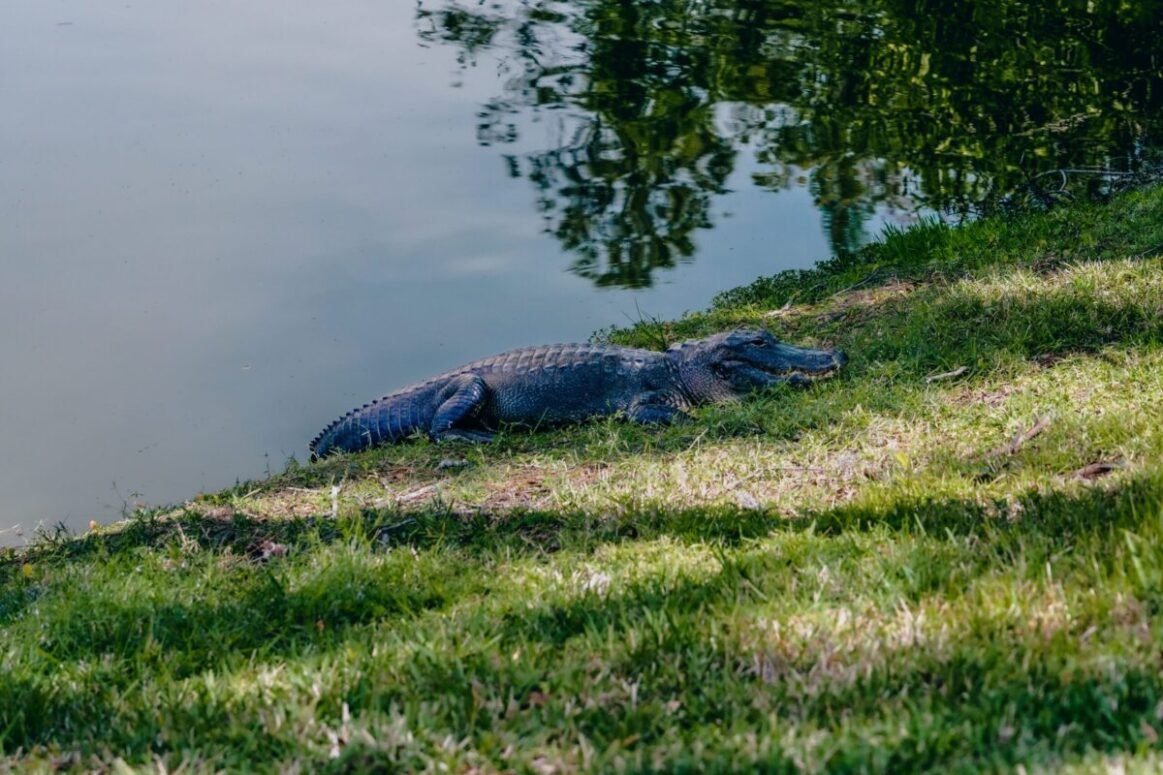
There’s a particular kind of excitement that comes with spotting an alligator when you’re out on a Florida lake.
At first, it might be nothing more than two bumps breaking the surface of the water. Then a snout appears. Maybe part of a back. If you’re lucky, the alligator slowly cruises into open water and gives you a better look.
“That’s a big one.”
Of course, everyone on the boat has a different definition of big.
Someone says eight feet. Someone else is certain it’s ten. Give the story another week and the alligator may be pushing twelve.
That’s part of the fun of living around alligators in Florida. They are wild animals that deserve plenty of respect, but they are also remarkably ordinary neighbors.
They turn up in lakes, canals and ponds. They bask along shorelines and occasionally appear on golf courses. A small one may take up residence in a canal for a while and then disappear as mysteriously as it arrived.
And once you’ve lived around them long enough, seeing an alligator doesn’t necessarily mean something dramatic is about to happen.
Sometimes it simply means there’s an alligator over there.
How Big Is That Alligator?
There is actually a clever way to answer one of the first questions people ask when they spot an alligator.
How big is it?
You don’t need to see the entire animal.
A commonly used field estimate looks at the distance between the alligator’s eyes and nostrils. Measure that distance in inches and it can give you a rough estimate of the animal’s total length in feet.
So, an alligator with roughly 10 inches between those points may be around 10 feet long.
It’s an estimate, not a substitute for stretching a measuring tape from the tip of an alligator’s nose to the end of its tail. And attempting the latter would be a spectacularly bad idea for the average person.
The trick is particularly useful because alligators are very good at hiding most of themselves.
An enormous body can be sitting just beneath the surface while all you see are eyes, nostrils and perhaps a little of the head.
That also helps explain Florida’s endless supply of giant-alligator stories.
Water, distance, perspective and a partially hidden animal make size surprisingly difficult to judge. A photograph taken from the right angle can make an already large alligator look positively prehistoric.
Some, however, really big become enormous.
Yes, Florida Has Some Giants
Male American alligators grow considerably larger than females. Mature males are sometimes called bulls, while females may be called cows and the babies are generally called hatchlings.
Females rarely grow beyond about 10 feet, while large males can exceed 12 feet. The truly exceptional males can reach 14 feet or more.
Florida’s official record for length is a male alligator from Lake Washington in Brevard County that measured 14 feet, 3½ inches. The state’s heaviest recorded alligator was a male from Orange Lake in Alachua County weighing 1,043 pounds.
That’s a lot of alligator.
Claims about 15-, 16- and even 20-foot monsters are another matter. Without a reliable measurement, giant-gator stories should be treated as exactly that: stories.
A 12-foot alligator doesn’t need any exaggeration. It’s already impressive.
Meet Yogi and Apollo
People who regularly see the same alligators sometimes start recognizing them.
And once you recognize them, sooner or later somebody gives them names.
Let’s call one of the big ones Apollo.
Apollo is the kind of alligator people notice. When his head appears above the water, everyone starts trying to estimate his size. Is he nine feet? Ten? Bigger?
Nobody is getting close enough to settle the argument.
Then there’s Yogi.
Yogi is considerably smaller, perhaps three or four feet long. For a while he regularly appears in the same canal. You begin expecting to see him there.
Then one day you don’t.
A few days become a few weeks. Vegetation grows along the water. Eventually Yogi seems to have vanished.
Nothing necessarily happened to him. Alligators move. Young alligators in particular may turn up somewhere else as they grow and search for suitable habitat.
Perhaps Yogi is a few canals away.
Perhaps he’ll turn up again.
Or perhaps someone else is looking out at the water right now thinking, Where did that little alligator come from?
That’s the thing about naming wildlife. The animal never agreed to the arrangement.
The Alligator on the Golf Course
Not every encounter is from a boat.
Florida golf courses can provide surprisingly good alligator habitat because many contain ponds, lakes and drainage areas.
Imagine a group of young golfers discovering an alligator near the course.
At first there’s excitement. Everyone wants to see it.
Then somebody gets too close.
Someone throws something.
Now the situation has changed.
The alligator hasn’t suddenly become the problem. The people have.
Throwing objects at an alligator, approaching it for a photograph or trying to make it move is not only foolish, it can provoke an animal that might otherwise have remained exactly where it was.
One of the most important lessons about living around alligators is also one of the easiest:
Leave them alone.
Watch from a safe distance. Take the picture from a safe distance. Then continue with your day.
The alligator probably will too.
When an Alligator Shows Up Where You Don’t Expect One
Seeing an alligator on a large Florida lake feels natural.
Seeing one in a small manmade pond surrounded by homes, roads and sidewalks can feel very different.
But the distinction makes more sense to humans than it does to an alligator.
Florida is covered with connected and disconnected pieces of freshwater habitat: lakes, marshes, rivers, canals, retention ponds and drainage systems. Alligators move between suitable areas, particularly during warmer months and breeding season.
That means an alligator can occasionally appear in a place where people are convinced it doesn’t belong.
The important question isn’t whether the pond looks sufficiently wild to us.
It’s whether the alligator has access to water, food and habitat.
This is one reason Florida residents are advised never to feed alligators. An alligator that naturally keeps its distance from people is far easier to live around than one that has learned humans mean food.
Feeding alligators is illegal in Florida for exactly that reason.
What Living with Alligators Really Means
Florida has an estimated 1.3 million alligators, spread across all 67 counties.
With numbers like that, avoiding every place an alligator could live would make enjoying Florida rather difficult.
Living around them doesn’t require being afraid of every lake.
It requires understanding a few boundaries.
Don’t feed them. Don’t approach them. Keep pets away from the water’s edge. Swim in designated areas during daylight hours rather than at dusk or dawn, when alligators are more active. And never assume that because an alligator hasn’t moved, it hasn’t noticed you.
Most importantly, don’t confuse familiarity with tameness.
An alligator you’ve watched for months is still a wild alligator.
Even if you’ve named him Apollo.
They’re Part of Florida
Perhaps that’s what changes after you’ve lived around alligators for a while.
The novelty fades, but the fascination doesn’t have to.
You can still enjoy that moment when something breaks the glassy surface of a lake and two eyes appear. You can still wonder how large the animal underneath them might be. You can still slow the boat and watch from a distance.
Sometimes it’s a giant male.
Sometimes it’s a little one that has temporarily claimed a canal.
Sometimes you see only a head before it quietly sinks beneath the surface and disappears.
There doesn’t have to be a dramatic encounter.
That’s what living with alligators in Florida is really like.
They’re not pets. They’re not monsters. And they don’t need to be either one to be interesting.
They’re simply part of the landscape, living their lives alongside millions of Floridians who have learned to do the same.
Just give Apollo his side of the lake.
He was probably there first.
Sources
- Florida Fish and Wildlife Conservation Commission (FWC) — American Alligator
- Florida Fish and Wildlife Conservation Commission (FWC) — Statewide Alligator Harvest Program and alligator size records
- Florida Fish and Wildlife Conservation Commission (FWC) — Living with Alligators and Crocodiles
- Florida Fish and Wildlife Conservation Commission (FWC) — Alligator safety and coexistence guidance
Reviewed by Claire Bennett, Managing Editor
Last reviewed: October 2026
Quick Answer Guide publishes practical, research-based answers to common questions about money, technology, health, travel, home improvement, and everyday life. Content is reviewed using official government resources, educational institutions, industry publications, and other authoritative sources when appropriate. Articles are updated periodically to improve accuracy and usefulness.