
A Backyard That Never Gets Boring
Who needs television when there’s an entire world of entertainment happening just outside the window?
From my home office, I have a perfect view of our backyard — a stage where cardinals, hummingbirds, woodpeckers, and a few unexpected guests provide more distractions than anything happening inside the house. Some days the yard is peaceful. Other days, it’s so lively that concentrating feels impossible.
And then there’s Rocky.
But we’ll get to him in a moment.
A Backyard Full of Life
One of the most beautiful features of our yard is an enormous magnolia tree. Its thick branches and evergreen leaves provide shelter for all sorts of birds. I can’t see their nests, but I’m convinced several of our regular visitors raise their families there.
Around the yard, flowering plants — especially the ones with bright red blossoms — attract hummingbirds. Just outside my office window, dense bushes give smaller birds a place to hide, explore, and chatter.
Our four‑foot fence has become a favorite gathering place. It’s the perfect height for birds to perch, survey their surroundings, and occasionally appear to be playing together.
Add a few birdfeeders, and we have what seems to be a very popular little neighborhood.
The best part? I don’t have to go anywhere to enjoy it. I just look out the window.
The Cardinals Are the Stars of the Show
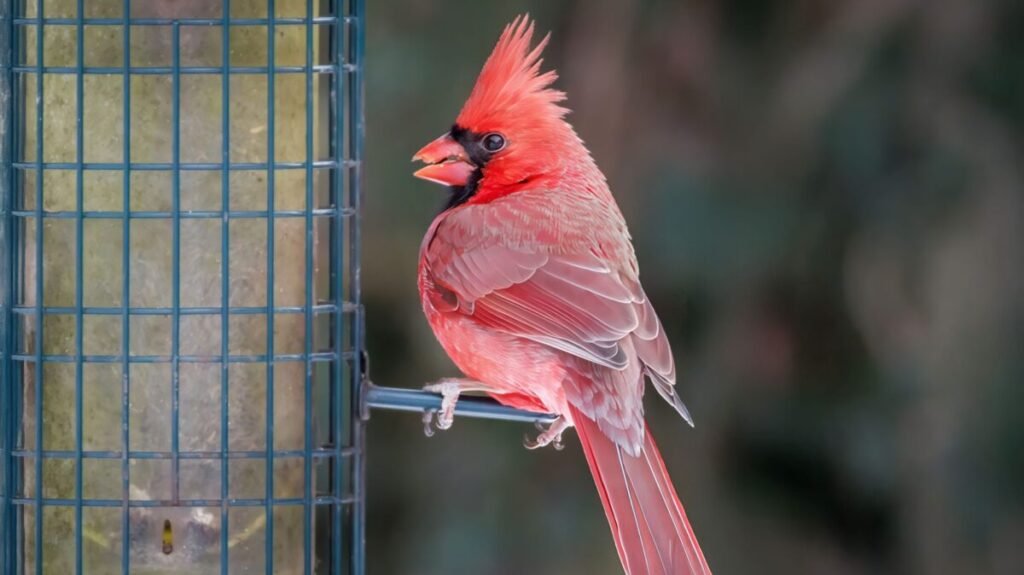
Of all our feathered visitors, the cardinals are the most frequent — and among my favorites.
There’s something magical about seeing a brilliant red male cardinal perched against the green leaves of a Florida garden. The males are unmistakable with their bright feathers and pointed crests. The females are beautiful in a softer way, with warm brown plumage touched by red around their wings, tails, and crests.
Cardinals live in Florida year‑round, so there’s always a chance of seeing one — whether it’s a warm summer morning or a cool winter afternoon.
But my favorite visitors might be the youngsters.
When the Baby Cardinals Arrive
They’re tiny, curious, and endlessly entertaining. They hop through the bushes outside my window, perch along the fence, and seem to discover something new every few minutes.
Young cardinals don’t immediately have the brilliant coloring of adult males. Their feathers are more subdued, and their bills start out darker. As they grow, their appearance gradually changes.
Even after leaving the nest, young cardinals may continue receiving food and guidance from their parents while learning to find food on their own.
It’s a lovely stage of their lives to observe.
One day, the bushes belong entirely to the grown birds. Then suddenly, there are youngsters exploring the same familiar branches. Before long, those little visitors will be grown too — and perhaps another generation will appear.
The Hummingbirds: Tiny Visitors With Big Energy
If the cardinals are the regular residents, the hummingbirds bring an entirely different kind of excitement.
They’re so small and move so quickly that spotting one feels like catching a glimpse of something extraordinary. A hummingbird can hover in place, fly forward, backward, and even briefly upside down. Its wings move so rapidly they become a blur.
Watching one maneuver around flowers is mesmerizing — especially when you consider how much energy such a tiny bird uses.
The ruby‑throated hummingbird is the species most commonly seen in Florida, though others occasionally appear. Their attraction to our red blossoms is no accident. Hummingbirds rely heavily on nectar, and many are drawn to red, orange, and pink tubular flowers.
Whatever brings them into the yard, I’m always happy to see them. They may be the smallest visitors, but they’re among the most entertaining.
And Then There Are the Woodpeckers
Woodpeckers bring their own personality to the backyard.
Unlike hummingbirds, which seem to be in constant motion, woodpeckers make their presence known through distinctive movements and sounds. Their strong bills allow them to investigate bark, search for insects, and excavate nesting cavities. Their specially adapted feet and stiff tail feathers help them cling to trunks and branches while they work.
Florida is home to several woodpecker species — including the red‑bellied, the downy, and the much larger pileated woodpecker. Seeing a pileated woodpecker is always a treat.
Each species has its own habits and quirks. No two seem to go about their daily business in quite the same way.
We even had a neighbor whose woodpecker seemed to follow him around, pecking on all the windows.
Rocky: The Uninvited Dinner Guest
Of course, not everyone visiting our birdfeeders has feathers.
Meet Rocky.
Rocky is our squirrel — although I’m fairly certain he considers himself one of the rightful owners of the backyard. And Rocky has friends. They spend time in the palm trees, apparently keeping a close eye on the neighborhood dining arrangements.
Unfortunately, Rocky believes anything placed in a birdfeeder should also be available to squirrels.
Every so often, I’ll look out my office window and discover he’s helping himself again. That’s when I have to stop whatever I’m doing, jump up, and chase him away.
Off he goes, back toward the palm trees and his squirrel companions.
You’d think he’d eventually understand the feeders are intended for birds. Rocky apparently has other ideas.
And he has one more problem to contend with.
Her name is Bella.
Bella’s Squirrel Patrol
Bella can be sound asleep, perfectly comfortable and oblivious to everything happening around her.
But let Rocky show up at the feeders, and suddenly she’s wide awake.
She jumps up and joins the effort to send him on his way. Apparently, protecting the birdfeeders is a responsibility she takes very seriously.
Between Bella and me, Rocky gets plenty of reminders that the feeders aren’t his personal buffet. But squirrels are persistent. Judging by Rocky’s continued visits, he isn’t planning to give up anytime soon.
His adventures have simply become another part of the entertainment outside my window.
Why Do Birds Love Some Backyards?
One thing I’ve learned from watching our backyard visitors is that attracting birds involves more than hanging up a feeder.
Trees, bushes, flowers, and other plants all contribute to making a yard appealing to wildlife. Birds need places to rest, hide, search for food, and raise their young.
A magnolia provides shelter. Shrubs offer protected areas for smaller birds. Flowering plants attract hummingbirds and insects. Even a simple fence becomes a useful perch.
Birdfeeders add another food source — as long as the food is fresh and the feeders are kept clean.
A backyard doesn’t need to be enormous or elaborate to attract wildlife. Sometimes it’s the combination of ordinary things that makes it special.
And perhaps that’s what makes watching them so interesting. They aren’t performing for us. They’re simply going about their lives.
We just happen to have a front‑row seat.
A Little Piece of Florida Right Outside the Window
Florida is famous for its beaches, springs, lakes, and extraordinary wildlife. Visitors travel from all over the world hoping to see dolphins, manatees, alligators, and unusual birds.
But some of the most enjoyable wildlife encounters happen much closer than people realize.
Sometimes they happen in an ordinary backyard.
For me, that means watching cardinals raise their families, seeing young birds explore the bushes, catching glimpses of hummingbirds, and enjoying the woodpeckers that make their way through the neighborhood.
It also means keeping an eye on Rocky and his friends — and occasionally watching Bella spring into action when squirrel patrol becomes necessary.
What makes the experience special isn’t any single bird or animal. It’s the pleasure of watching this little community go about its daily life.
Some days are quiet. Others are full of surprises. But there’s rarely a dull moment outside my office window.
And the nicest part?
I never have to leave my desk to enjoy a little bit of Florida’s wonderful wildlife.
Sources & References
The personal experiences in this article are firsthand observations. The following resources support the general information about Florida’s backyard birds, their behavior, and bird-friendly landscaping.
- Cornell Lab of Ornithology: Northern Cardinal Life History
- Cornell Lab of Ornithology: Northern Cardinal Identification
- University of Florida IFAS Extension: Hummingbirds of Florida
- University of Florida IFAS Extension: Bird-Friendly Plants
- National Audubon Society: Tips for Feeding Backyard Birds
- National Audubon Society: Downy Woodpecker
Editorial Review
Prepared for review by Claire Bennett, Managing Editor, Quick Answer Guide
October 2026
Claire Bennett reviews articles for editorial quality, accuracy, clarity, readability, and consistency with Quick Answer Guide’s publishing standards. Wildlife information is researched using authoritative sources, including established ornithological organizations and educational institutions.