
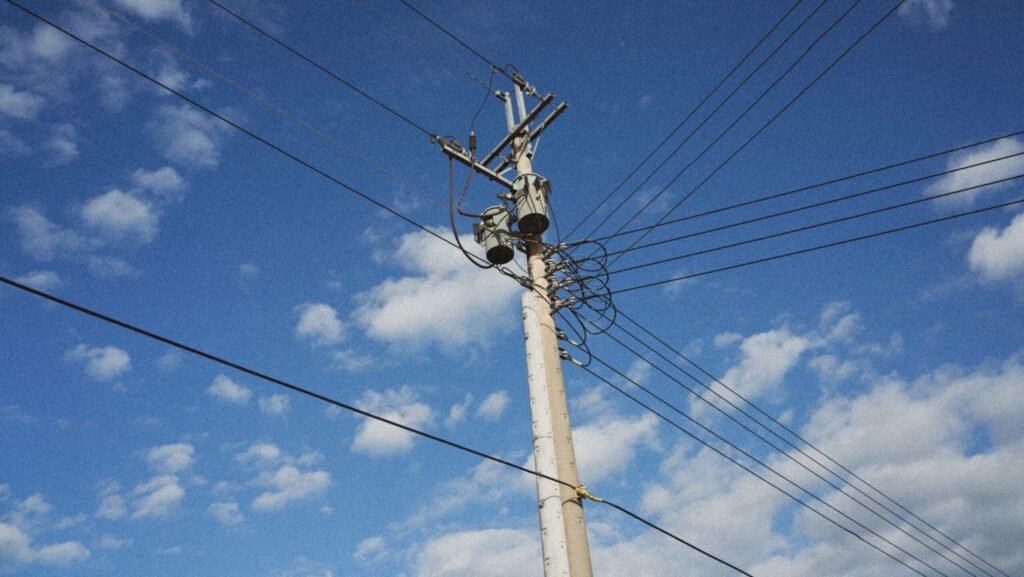
If traditional home telephone lines are disappearing and so many newer neighborhoods have underground cable, fiber, and electric service, what are all those wires on utility poles actually carrying?
It is a surprisingly good question because the familiar term “telephone pole” no longer describes what most of these poles actually do. A pole beside the road may carry electricity, cable television, internet service, fiber-optic connections, older copper telephone circuits, streetlights, traffic equipment, and wireless antennas—all at the same time. It may also serve as the point where overhead lines descend into underground conduits before entering a neighborhood.
Once you know how a typical pole is arranged, that confusing collection of wires starts to look more like an organized vertical map. The highest area is generally reserved for electric power. Communication cables usually occupy the lower portion. Also, the cans, tubes, boxes, loops, braces, and warning tags attached between them each have a purpose.
Quick Answer
Most utility poles carry a combination of electric-distribution equipment and communication cables. So to start with on a typical shared pole, the highest wires are primary electric-distribution conductors carrying thousands of volts. And then, below them may be transformers, protective devices, neutral and secondary power conductors, and service wires leading to buildings. Continuing further down, in a separate communications area, may be coaxial cable for television and internet, fiber-optic cable, older copper telephone cable, municipal communications, or equipment supporting wireless service.
Cable and fiber are not always underground. Both can be installed overhead, particularly where poles already exist. Even when every service inside a subdivision is buried, poles outside the development may still carry the main electric or communications lines feeding that underground system.
There is no safe way for an untrained observer to identify every line from the ground. Pole arrangements differ, and a low wire should never automatically be treated as harmless. Any fallen, damaged, or unusually low line should be avoided and reported.
What Is Usually on a Utility Pole?
The exact equipment varies by location, utility, voltage, and the services available in the area. A common pole may include some or all of the following:
| Approximate area | What may be there | What it does |
| Top of the pole | Primary electric conductors | Carry distribution-level electricity from a substation through the community |
| Upper power area | Crossarms and insulators | Hold energized conductors apart and away from the pole |
| Upper power area | Fuses, cutouts, switches, arresters, or reclosers | Protect equipment and isolate faults |
| Upper or middle power area | Pole-mounted transformer | Reduces distribution voltage to a level used by nearby customers |
| Below the primary conductors | Neutral and secondary conductors | Complete parts of the electric circuit and distribute lower-voltage power |
| From pole to building | Electric service drop | Delivers electricity to an individual home or business |
| Separated lower area | Coaxial cable | Carries cable television and cable-internet signals |
| Separated lower area | Fiber-optic cable | Carries data as light through thin glass or plastic fibers |
| Separated lower area | Copper telephone cable | May support traditional voice service, DSL, alarms, or other legacy circuits |
| Various permitted locations | Streetlights, antennas, cameras, sensors, and control equipment | Supports lighting, wireless service, transportation, or public systems |
| Side of the pole | Grounding conductor, conduit, riser, tags, and identification plates | Grounds equipment, protects vertical cable, connects overhead and underground systems, and identifies assets |
| Beside the pole | Guy wire and anchor | Helps the pole resist the sideways pull of suspended wires |
That order is a useful guide, not a do-it-yourself identification system. Some poles carry only communications lines. Others carry only electricity. Some carry several electric circuits, and some support equipment that is difficult to identify even for experienced observers without records or labels.
Why Do We Still Call Them Telephone Poles?
“Telephone pole” survived because telephone companies were among the earliest widespread users of pole lines, and the name became part of everyday language. Today, utility pole is more accurate. A pole may be owned by an electric utility, a telephone company, a municipality, a cooperative, or another infrastructure owner.
Many are joint-use poles, meaning more than one company has facilities attached to the same structure. The pole owner does not necessarily own every wire. An electric utility might own the pole and the power equipment, while one or more telephone, cable, fiber, or wireless companies lease attachment space below.
This shared arrangement avoids placing a separate row of poles along the same road for every provider. It also explains why repairing, replacing, or removing one pole can require coordination among several organizations.
A Top-to-Bottom Tour of a Typical Utility Pole
Looking from the top downward is the easiest way to understand a common distribution pole. The following arrangement is typical in the United States, but it is not universal.
1. Primary Electric-Distribution Wires
The highest conductors on a conventional shared pole are usually the primary electric-distribution lines. They bring electricity from a local substation toward neighborhoods and businesses. These are not the enormous long-distance transmission lines suspended from tall steel towers, although some poles can carry higher-voltage subtransmission circuits.
Primary distribution wires operate at much higher voltage than household wiring. The precise voltage depends on the utility and circuit. FirstEnergy, for example, describes primary distribution voltages in its system as ranging from 2,400 to 34,500 volts. The important point for a passerby is not the exact number: it is that these lines may carry thousands or tens of thousands of volts.
A pole may hold one primary conductor, three phase conductors, or another configuration. Three conductors commonly indicate a three-phase circuit, but counting wires is not a reliable way for the public to determine the voltage or system design.
Some primary conductors appear bare because overhead systems use air, distance, and insulators to maintain separation. Other conductors may have a covering. A dark coating should never be assumed to make a line touch-safe. Utilities and safety agencies advise treating overhead power lines as energized and dangerous regardless of appearance.
2. Crossarms and Insulators
The horizontal wooden, fiberglass, or metal bar near the top is a crossarm. It supports the conductors and maintains the spacing required for the system.
The small ridged pieces between a conductor and the crossarm or pole are insulators. They are commonly made from porcelain, glass, or polymer materials. Their job is to support energized conductors while limiting current from traveling into the crossarm or pole.
Some modern construction uses brackets or vertical arrangements rather than a traditional horizontal crossarm. A pole without a visible crossarm may still carry high-voltage distribution wires.
3. Cutouts, Fuses, Switches, and Surge Protection
The narrow tube or hinged device hanging near a transformer is often a fused cutout. It helps protect a transformer or branch circuit. If excessive current flows, a fuse can open the circuit. Some cutouts visibly drop into an open position, which can help a lineworker locate the affected equipment.
Nearby may be a surge arrester, which helps protect equipment from voltage surges, including those associated with lightning. Depending on the circuit, a pole may also carry switches, reclosers, sectionalizers, sensors, or other protective and control devices.
A recloser can interrupt current after a fault and may automatically attempt to restore the circuit. That is one reason power can blink off during a storm and then return seconds later. If the problem remains, protective equipment may keep the affected section disconnected.
These devices are utility equipment, not controls that a property owner should attempt to operate.
4. The Large Gray Can: A Distribution Transformer
One of the most recognizable pole-mounted objects is the round gray, silver, or greenish metal can. It is usually a distribution transformer.
Electricity travels efficiently through the distribution system at a voltage far above what a home can use. The transformer reduces that primary voltage to the lower secondary voltage supplied to nearby customers. In a typical U.S. residence, the service commonly provides 120/240 volts.
One transformer may serve one building or several nearby homes, depending on its capacity and the local system. Larger loads may require multiple transformers or a three-transformer bank. In areas with underground electric distribution, the same general job may be performed by a locked pad-mounted transformer—the green cabinet people often see near sidewalks or property lines.
Transformers may hum quietly during normal operation, but arcing, flames, smoke, leaking fluid, a sudden loud bang, or an unusually intense buzzing sound should be reported from a safe distance. No one should approach a pole to investigate the source.
5. The Neutral Wire
Below the primary conductors, a pole may carry an electric-system neutral. Its precise position and function depend on the utility’s distribution design. It may provide a return path for current, help stabilize the system, and be connected to grounding conductors at multiple locations.
The neutral is not a “safe wire.” Electrical faults, broken connections, lightning, induced voltage, or contact with another conductor can create hazardous conditions. It belongs to the electric supply space and should be treated accordingly.
6. Secondary Electric Wires
After voltage is reduced by the transformer, secondary conductors carry lower-voltage electricity along the street or between poles. OSHA’s electric-power glossary describes secondaries as conductors originating at a distribution transformer’s low-voltage secondary winding.
These wires are generally below the primary conductors but above the communications area. A bundled secondary cable can look like a single thick black line even though it contains multiple conductors. Because of that, the common assumption that “thick black cable means internet” is unsafe.
Lower voltage does not mean low risk. Household-level electric service can cause fatal shock, burns, fires, and arcing.
7. Electric Service Drops
The line running from a pole toward an individual house is called an overhead service drop when it supplies electricity. It normally connects the utility’s secondary system to the customer’s service entrance and meter.
The service drop may be bundled and may sag gently between the pole and the building. A separate cable or fiber drop from an internet provider can follow a similar route, so direction alone does not prove which company owns a line.
Responsibility for equipment near the house varies. The utility typically owns its service conductors up to a defined connection point, while the property owner may be responsible for items such as the service mast, weatherhead, meter enclosure, or building attachment. The exact division must be confirmed with the local utility.
8. The Safety Space Between Power and Communications
Power and communication facilities are not supposed to be attached randomly. Codes and utility construction standards establish separation and working-space requirements. A joint-use pole generally has electric supply space above and communications space below, with a designated safety zone between them.
Many standards describe a communications worker safety zone of approximately 40 inches, although the required clearance can vary with voltage, construction, location, and the governing edition of applicable rules. The visible gap helps protect communications workers from the energized supply area above.
That open section is not spare room for signs, decorations, birdhouses, cameras, flags, or private wiring. Unauthorized objects can block climbing space, conceal damage, add structural load, or create hazards for workers.
9. Cable-Television and Cable-Internet Lines
One or more of the lower cables may belong to a cable company. Cable systems can distribute television and internet over coaxial cable, often as part of a hybrid fiber-coaxial network.
In a hybrid system, fiber carries large amounts of data from the provider’s network to an optical node serving a local area. Coaxial cable completes part of the route toward individual homes. This means the cable running along a street can still be part of an internet network even if the company advertises a fiber-rich system.
Coax frequently hangs from or is lashed to a supporting steel messenger strand. Along the route, there may be taps, splitters, amplifiers, nodes, and power-related equipment. A tap provides connection points for drops going to customers. An amplifier helps maintain usable signals over portions of a coaxial network. A node converts between optical and radio-frequency signals in a hybrid fiber-coaxial system.
These devices may look like rectangular or cylindrical metal housings placed inline with the lower cable. They should not be opened, moved, painted, or treated as abandoned simply because their purpose is not obvious.
10. Fiber-Optic Cable
Fiber-optic cable is not confined to underground conduit. It is often attached to existing poles, particularly when aerial construction is practical and suitable attachment space is available. Federal broadband guidance recognizes both aboveground pole attachments and underground placement in public rights-of-way.
Instead of carrying information as electrical signals through copper, optical fibers carry data using light. A fiber cable can support residential internet, business networks, cellular sites, schools, public safety systems, traffic equipment, or connections between major network facilities.
From the ground, aerial fiber can resemble coaxial or telephone cable. Clues may include provider tags, specialized splice enclosures, or deliberately stored loops, but there is no universal appearance that allows a member of the public to identify it confidently.
Fiber itself does not conduct electricity in the way a copper conductor does. However, a fiber cable assembly may include metallic strength members, a messenger wire, armor, tracing components, or nearby powered equipment. More importantly, any fallen cable may have contacted an energized power line. It should never be handled to find out what it is.
11. Older Copper Telephone Cable
Some of the lower wires really are telephone lines—or were originally installed for telephone service. Traditional telephone networks used bundles containing many pairs of copper wires. Those pairs could serve voice lines, fax machines, dial-up connections, DSL internet, alarm circuits, and other services.
The nationwide transition away from aging copper networks is real, but it is not complete. The Federal Communications Commission still maintains rules and notices concerning copper retirement because providers continue to replace or disable copper facilities in particular areas over time. That process happens network by network, not everywhere on one date.
An older copper cable on a pole may therefore be:
- actively serving customers;
- retained for a business, alarm, DSL, or specialized circuit;
- present as backup or spare capacity;
- disconnected but not yet removed; or
- awaiting confirmation and coordinated removal.
Appearance alone cannot reveal which condition applies.
12. Wireless, Municipal, and Public Equipment
Utility and streetlight poles increasingly support equipment that is not a traditional wireline service. Depending on local agreements and permits, a pole may hold:
- a small wireless antenna or radio;
- cellular backhaul fiber and an equipment enclosure;
- a traffic camera or vehicle sensor;
- public-safety communications;
- a streetlight and its control equipment;
- a weather or environmental sensor;
- municipal fiber;
- fire-alarm or emergency communications wiring; or
- monitoring equipment used by the electric utility.
Small-cell installations vary widely. A compact antenna may be placed near the top of a specially designed pole or attached to the side of an existing structure, with a nearby radio or equipment cabinet and a fiber connection. Not every unfamiliar cylinder is a cellular antenna, and not every camera belongs to law enforcement; equipment purpose and ownership must be confirmed through the local authority or provider.
What Are the Black Loops of Cable Hanging from Some Poles?
Large loops of black cable can look unfinished or careless, but they often serve an intentional purpose. Fiber and other communications crews store extra cable, known as slack, near selected poles and splice points.
Slack provides enough cable for a technician to bring a splice enclosure to a workable position, redo a damaged splice, reroute a short section, or accommodate a future connection without replacing an entire span. Fiber also has minimum bend-radius requirements, so excess cable may be supported on curved “snowshoe” brackets instead of being wrapped into a tight coil.
The loop may be associated with:
- a fiber splice location;
- a future network extension;
- repair reserve;
- a transition into underground conduit;
- a service terminal; or
- planned construction that is not yet complete.
A very loose, broken, or unusually low loop may still indicate damage. The fact that some loops are intentional does not mean every dangling cable is normal.
What Are the Long Black Cylinders or Bulging Cases?
A sealed black or dark-gray enclosure attached to a communications cable is often a splice closure. It protects delicate fiber or copper splices from rain, dust, insects, temperature changes, and physical damage.
Fiber strands cannot simply be twisted together. Technicians align and fuse or mechanically join fibers, organize them in trays, and seal the splices inside a weather-resistant enclosure. Copper telephone cables use their own closures and terminals to organize and protect many wire pairs.
The shape is not conclusive. Splice housings can be cylindrical, oval, rectangular, or dome-shaped, and cable-system devices can have similar silhouettes. Provider markings and engineering records are more dependable than appearance.
What Are the Metal Boxes Attached to the Lower Lines?
Metal boxes in the communications area may be cable amplifiers, fiber nodes, taps, power supplies, network terminals, or control equipment. Some are powered through the cable network or through a separate electrical connection.
This is one reason “communication line” does not mean “contains no electricity.” Coaxial networks may carry power for active field equipment. Copper telephone circuits can also have electrical voltage. Even a nonconductive fiber path may be attached to conductive support hardware or located beneath energized supply lines.
If a box is open, hanging, sparking, or damaged, report it to the appropriate provider or electric utility without touching it.
What Is the Wire Running Straight Down the Pole?
Several different facilities can run vertically along a pole.
Grounding conductor
A grounding wire may connect electric equipment and the system neutral to a ground electrode. It is often covered by a protective molding near the base. It is part of the utility’s safety and protection system and should not be cut, loosened, or used as an attachment point.
Riser cable in conduit
A thicker cable enclosed in pipe may be a riser connecting an overhead system with an underground system. Power risers use specialized terminations near the top. Communications cables can also descend through protective conduit before continuing underground.
Equipment supply or control cable
Streetlights, antennas, cameras, and network equipment may require vertical power or data cables. Their placement and protection depend on the installation.
Because all three can appear as a narrow vertical line or pipe, they cannot be reliably identified merely by standing beneath the pole.
What Is the Diagonal Cable Anchored in the Ground?
A diagonal cable running from the pole to the ground is usually a guy wire. Suspended wires pull sideways on a pole, especially at corners, dead ends, road crossings, and changes in elevation. The guy wire transfers some of that force to an anchor in the ground.
The bright yellow or other colored sleeve near its lower portion is a guy guard. It makes the wire easier for pedestrians, drivers, landscaping crews, and equipment operators to see. The guard is not what holds the pole upright.
A guy wire is normally structural rather than a power conductor, but it is still utility equipment located near energized facilities. A broken, loose, or vehicle-struck guy wire can destabilize a pole or contact electrical equipment and should be reported without being touched.
Why Are There Tags, Numbers, and Colored Markers on the Pole?
Pole tags help utilities identify a specific structure in inspection, maintenance, outage, and attachment records. A tag may show an asset number, owner abbreviation, inspection mark, treatment date, height or class, or other internal information.
Communication providers may place small colored tags near their cables so workers can distinguish one network from another. Fiber cables are often labeled, but tag color is not sufficiently standardized nationwide for a public color chart to be dependable.
Other markings may indicate underground facilities, grounding, inspection status, hazardous materials in older equipment, or construction notes. They are intended for qualified workers and asset management—not as permission for the public to climb or inspect the pole.
If Utilities Are Underground, Why Are There Still Poles Outside the Neighborhood?
“Underground neighborhood” rarely means that every mile of every supporting network is buried from its source to each house. Often only the local distribution and service lines inside the development are underground.
The larger route may work like this:
- Overhead electric or communications lines travel along a main road.
- At a selected pole near the subdivision, the lines enter protective conduit.
- Underground cable continues through the neighborhood.
- Pad-mounted transformers, pedestals, handholes, vaults, or cabinets distribute service locally.
- Buried service lines run from those facilities to individual homes.
The transition structure is commonly called a riser pole. OSHA’s electric-power glossary defines a riser as equipment that connects an overhead line to an underground line, with conduit traveling up the pole to specialized terminations.
This arrangement explains why a neighborhood can have no wires between its houses while nearby roadside poles remain essential. Those poles may be carrying the feeder that supplies the buried system.
Why Aren’t All Power, Cable, and Fiber Lines Buried?
Underground construction has real advantages, but it is not automatically practical everywhere.
Existing poles make aerial construction efficient
Where a usable pole route already exists, adding an approved communications attachment can avoid extensive trenching, boring, pavement cuts, restoration, and conflicts with other buried utilities. Federal Highway Administration broadband guidance notes that trenching is often one of the most expensive parts of fiber deployment.
Ground conditions and rights-of-way differ
Rock, wetlands, high groundwater, narrow rights-of-way, bridges, rail crossings, crowded underground corridors, mature tree roots, and existing pavement can complicate burial. Aerial construction has its own challenges, including pole capacity, clearance, storm exposure, vegetation, permits, and attachment coordination.
Underground equipment is not immune to failure
Buried lines are protected from many falling trees, vehicle strikes, wind loads, and some lightning exposure. They can still be damaged by excavation, flooding, water intrusion, soil movement, animals, failed splices, or aging equipment. Underground faults may also require specialized testing and excavation to locate and repair.
Conversion is a major infrastructure project
Moving an existing overhead system underground involves more than digging a trench. Utilities may need new easements, conduits, vaults, pad-mounted transformers, switches, service conversions, road restoration, permits, and customer-property modifications. Who pays depends on local tariffs, public projects, utility programs, and the reason for conversion.
Networks evolve in sections
Utilities and communications companies replace or expand infrastructure in phases. A fiber provider may use underground construction in one development, aerial attachments on an older street, and a combination of both along the route connecting them.
Has the Traditional Home Telephone Line Disappeared?
The traditional copper landline is declining, but “landline” can now describe several different services.
Traditional copper telephone service
Classic telephone service used a copper pair connecting a home to the telephone network. In some areas, active copper facilities still remain.
Cable-based home phone
Many cable companies provide home telephone service through a modem or gateway. The telephone in the house may look traditional, but the outside network may be hybrid fiber-coaxial rather than an old telephone copper loop.
Fiber-based home phone
Fiber providers can deliver voice service through an optical network terminal at the home. That terminal and the home’s router or gateway usually require local electricity and may have a battery-backup option.
Fixed wireless or cellular-based home phone
Some services connect a home telephone through a cellular or fixed-wireless device.
Internet-based calling
Voice over Internet Protocol, or VoIP, carries calls through an internet connection rather than a traditional analog telephone network.
So the household telephone has not necessarily vanished; the path carrying the call has changed. A phone plugged into a wall jack does not by itself reveal whether the outside connection is copper, coaxial cable, fiber, or wireless.
Why Might Old Telephone Wires Remain After Service Ends?
Some unused facilities do remain on poles, but it is impossible to decide from appearance alone that a particular cable is abandoned.
Removal can be delayed because:
- a cable still serves one or more customers;
- records must be checked before it can be disconnected;
- several providers share the pole;
- removing it could disturb active lines lashed to the same support strand;
- traffic control, permits, or specialized crews are required;
- pole replacement work must occur in a particular order;
- ownership is uncertain after mergers or network transfers;
- the facility is reserved for another purpose; or
- removal has simply not yet been scheduled.
Abandoned attachments and “double poles” are genuine concerns in some communities. A double pole occurs when a new pole is installed next to an old one but not every company has transferred its equipment. The old pole cannot be removed until the remaining attachments are relocated and responsibility is resolved.
That coordination can be frustratingly slow because the electric utility, telephone provider, cable company, municipality, and other attachers may each own different facilities. State and local rules concerning transfer and removal timelines vary.
Can You Tell Power, Cable, Fiber, and Telephone Lines Apart?
You can sometimes make an educated observation from a safe public location, but not a definitive identification.
| Visual clue | What it may suggest | Why it is not proof |
| Highest wires on insulators or crossarms | Primary electric distribution | Pole designs vary, and some communication-only poles have no power |
| Bundled line below a transformer | Secondary electric conductors | Communication cables can also look thick and bundled |
| Lowest horizontal cables | Communications facilities | A damaged power conductor may fall lower, and configurations vary |
| Cable lashed to a steel messenger | Coax, fiber, or copper communications cable | All three can use similar support methods |
| Large smooth loop or snowshoe-shaped storage | Often fiber slack | Other communications cables may also have stored slack |
| Sealed black cylinder or dome | Often a splice closure | Copper, fiber, and other equipment use varied housings |
| Metal box inline with lower cable | Cable amplifier, node, tap, power supply, or network equipment | Models and functions differ by provider |
| Pipe running up the pole | Overhead-to-underground riser | It may contain power or communications cable |
| Wire running to a house | Electric, cable, fiber, or telephone drop | Several services can follow similar paths |
Provider tags can help, but labels may be missing, faded, obstructed, or intended for workers who know the local system. A photograph reviewed by the utility or provider is more useful than guessing—provided the picture is taken from a safe location without approaching, climbing, or touching anything.
Why Do Some Poles Have So Many More Wires Than Others?
The number of visible lines does not simply measure how many homes are nearby. A busy pole may be at a route intersection, network branch, transformer location, underground transition, road crossing, or communications splice point.
It may also carry overlapping generations of infrastructure. One communications provider may have coax, another may have fiber, and a telephone company may still have copper. A municipality may operate its own traffic or public-safety fiber. The electric utility may have primary, secondary, neutral, streetlight, and control facilities.
At a simple stretch between branches, the next pole may support only the continuous lines. That is why one pole can look nearly bare while another half a block away appears packed with equipment.
Why Are Some Wires Tight While Others Sag?
Overhead conductors and cables are installed with planned sag. They expand and contract as temperature changes, and they must withstand wind, ice, their own weight, and forces on the poles. A perfectly tight wire would place excessive tension on the conductor and its supports.
Different materials, span lengths, temperatures, and installation requirements create different curves. Fiber, coax, copper, primary conductors, and bundled secondaries need not hang at identical heights or tension.
Normal design sag should not be confused with a newly fallen or dangerously low line. Warning signs include a sudden change after a storm or vehicle crash, a cable within reach, a line lying on the road, broken hardware, a sharply leaning pole, or conductors touching objects they did not previously touch.
Can Utility Poles Carry Internet Even If No Cable Goes Directly to Your House?
Yes. A pole route can be part of the broader network without providing an aerial drop to every customer beside it.
For example, fiber on a main road may connect:
- an underground residential network;
- a cable company’s optical node;
- a cellular small cell or tower;
- a school, hospital, government building, or business;
- two network hubs;
- traffic signals and cameras; or
- another community farther down the route.
Some fiber is middle-mile or backbone infrastructure rather than the final connection to a residence. It can pass a house without service being offered at that address. Availability depends on the provider’s network design, access points, electronics, capacity, and service plans—not merely on whether a fiber cable is visible nearby.
Does Fiber Need Electricity on the Pole?
The light traveling inside an optical fiber does not require electrical power along every span in the way an amplified coaxial system may. That is one advantage of passive optical distribution.
However, fiber networks still use powered equipment at various points, including provider facilities, optical line terminals, active Ethernet switches, wireless radios, cable nodes, and customer optical network terminals. A fiber cable may also be installed with conductive support or protective components.
As a result, seeing fiber does not mean the entire internet connection will operate during a power outage. The provider’s upstream equipment, local field equipment where applicable, the optical terminal at the home, the router, and the customer’s devices all need adequate power or backup power.
Why Can Birds Sit on a Power Line?
A bird perched on a single conductor is normally at nearly the same electrical potential at both feet. With no meaningful voltage difference across its body and no path to ground, little current flows through it.
The situation becomes dangerous if the bird touches another conductor at a different voltage or simultaneously contacts energized equipment and a grounded object. Larger birds and animals are more likely to bridge those gaps.
This does not make the wire safe for a person. A person on a ladder, tree, roof, pole, or the ground can create a path between different electrical potentials. Human reach, conductive tools, and contact with grounded surroundings make the circumstances completely different.
Are the Lowest Wires Safe to Touch?
No. Lower wires are often communications cables, but they should not be touched for several reasons:
- the line may have been misidentified;
- a fallen communications cable may be in contact with an energized power conductor;
- coaxial and copper systems can carry electrical voltage;
- damaged poles and guy wires can shift without warning;
- storm conditions can energize normally nonenergized hardware; and
- moving a cable can damage active service or create additional hazards.
OSHA instructs workers to presume power lines are energized unless the utility confirms otherwise and establishes required protective conditions. Members of the public should use an even simpler rule: never touch, lift, drive over, or attempt to move a downed line.
What Should You Do If a Wire Falls or Hangs Too Low?
If a line is down, damaged, sparking, or within reach:
- Stay well away from it. Many electric utilities advise keeping at least 30 feet from a downed line, and greater distance may be necessary in wet conditions or around large equipment.
- Keep children, pets, neighbors, and vehicles away.
- Do not touch anything contacting the line, including a fence, tree, vehicle, puddle, cable, or guy wire.
- Call 911 if there is immediate danger, fire, a traffic hazard, or a person or vehicle involved.
- Report the location to the electric utility. If it is confirmed to be a communications line, also notify the appropriate telephone, cable, or fiber provider.
- Do not rely on an outage, lack of sparks, or the line’s appearance as proof that it is de-energized.
If a power line falls on a vehicle, occupants are generally safest remaining inside and calling 911 unless fire or another immediate danger forces an exit. Emergency dispatchers can provide situation-specific instructions. Escaping an energized vehicle requires a special procedure because touching the vehicle and ground at the same time—or taking ordinary steps across energized ground—can be dangerous. Follow the dispatcher’s instructions whenever possible rather than leaving a safe vehicle unnecessarily.
What Should You Report Even If Nothing Has Fallen?
Contact the responsible utility or local authority if you notice:
- a pole that suddenly leans or cracks;
- wires brought down by a tree or vehicle;
- arcing, sparks, smoke, or fire;
- a transformer leaking fluid;
- a guy wire that has snapped or pulled loose;
- an open or hanging equipment enclosure;
- a line low enough to be reached or struck by traffic;
- exposed underground cable after erosion or excavation;
- repeated loud electrical noises; or
- a damaged pole after a crash, even if service still works.
If ownership is uncertain and electrical danger is possible, start with 911 for an immediate hazard or the local electric utility for a nonemergency report. Do not approach the pole looking for a company label.
Common Myths About Utility-Pole Wires
Myth: Every lower wire is an obsolete telephone line
The communications area may contain active fiber, coaxial cable, copper telephone cable, municipal networks, or multiple providers’ facilities.
Myth: Fiber is always buried
Fiber can be buried, placed in conduit, installed underwater, or attached to poles. A single network often uses more than one construction method.
Myth: A covered black line is insulated and safe
Appearance is not a safety rating. Some electric conductors are covered but not designed for contact, and bundled electric service can resemble communications cable.
Myth: If a neighborhood has underground service, nearby poles are unnecessary
The poles may carry the feeder to the neighborhood and transition into underground conduit at a riser pole.
Myth: A line that is not sparking is de-energized
An energized line can be silent and motionless. Protective equipment may also attempt to re-energize a circuit.
Myth: Fiber has no electricity, so a fallen fiber cable is safe
The optical fibers transmit light, but the cable assembly or support may include metal, nearby equipment can be powered, and a fallen cable may contact an energized conductor.
Myth: The electric company owns everything on the pole
Joint-use poles can hold attachments belonging to several companies and public agencies.
Myth: A new pole beside an old pole means the job was forgotten
It may be a delayed double-pole transfer. The old pole often must remain until every owner moves its attachments, although excessive delays can become a regulatory or community concern.
How the Pole Connects the Modern World
A utility pole is less an outdated remnant of the telephone era than a shared platform linking several infrastructure systems.
The power equipment at the top supplies homes, businesses, streetlights, traffic devices, communications electronics, and the devices people use to reach the internet. The lower cables may carry television, phone calls, streaming video, cloud backups, security-camera footage, emergency communications, and fiber traffic between major network points. A riser may quietly send those services underground before they enter a neighborhood.
That is why poles have not disappeared along with many traditional home telephone lines. Their role has expanded. The familiar wooden structure beside the road may now support both a century-old style of electrical distribution and some of the fastest digital communications available.
Related Articles
Curious about the infrastructure working around you? Explore these related articles:
- How Long Does It Take for Data to Cross the Ocean Through an Undersea Cable?
- How Long Does It Take to Reboot a Router?
- How Long Does It Take to Reset Wi-Fi?
Frequently Asked Questions
Are telephone poles still used for telephone service?
Yes, in some places. Poles may still carry active copper telephone cable, but they also carry cable, fiber, electric power, and other services. Many modern home-phone services use cable, fiber, internet protocol, or wireless networks rather than a traditional copper loop.
Is the top wire always a power line?
On a typical joint-use distribution pole, the highest conductors are generally electric power lines. However, pole configurations vary, and some communication-only poles carry no electric supply. Never use position alone as proof that a particular line is safe.
Is the bottom wire always a telephone line?
No. The lowest horizontal cable might be telephone, coaxial cable, fiber, municipal communications, or another provider’s facility. Several communication cables may occupy the lower area.
Can cable internet and fiber be installed on the same pole?
Yes. Multiple providers and technologies can share a pole when attachment rights, structural capacity, clearances, and applicable construction requirements are satisfied.
What is the big round can on a pole?
It is usually a distribution transformer. It reduces higher distribution voltage to the lower voltage used by nearby homes or businesses.
What are the big loops of black cable?
They are often stored communications-cable slack, especially near fiber splice points. Extra cable allows technicians to splice, repair, or reroute the line while respecting minimum bend requirements.
What is the black cylinder attached to a cable?
It may be a sealed splice closure protecting fiber or copper connections. Cable-network devices and terminals can look similar, so its exact function cannot be confirmed solely by shape.
Why are two utility poles sometimes standing side by side?
A new pole may have replaced a damaged, undersized, or deteriorated one, while some providers’ lines remain attached to the old structure. This temporary condition is often called a double pole. The old pole is removed after the required transfers are completed.
Can a utility pole feed an underground neighborhood?
Yes. Overhead lines can descend through conduit on a riser pole and continue underground. The poles outside the development may be essential even when no overhead wires appear between the homes.
Do fiber-optic cables carry electricity?
The optical fibers transmit information using light rather than electrical current. However, the cable may include conductive support components, and associated network equipment requires power. A fallen fiber cable can also contact energized lines and must not be touched.
Do old telephone wires still have voltage?
An active copper telephone circuit uses electrical signals and can have voltage present. A cable that looks old may also contain active pairs. Never cut, handle, or test it yourself.
Who owns a utility pole?
Ownership varies. The pole may belong to an electric utility, telephone company, municipality, cooperative, or another infrastructure owner. Other companies may own licensed attachments on it.
Can homeowners attach signs, cameras, lights, or decorations to a utility pole?
Generally, no—not without the pole owner’s authorization and any required permits. Private attachments can create climbing hazards, damage the pole, violate utility rules, or interfere with workers and existing facilities.
Why are power wires placed above communication wires?
In general, separating the supply space from the communications space helps maintain electrical clearances and gives communications workers a designated area below the higher-voltage equipment. However, exact requirements depend on governing codes, voltage, and utility standards.
Can a communication cable become energized?
Yes. For example, it can contact a fallen power conductor, be affected by damaged equipment, or carry network power as part of certain systems. Therefore, all downed wires should be treated as potentially energized.
Who should be called about a low-hanging wire?
Call 911 if it creates an immediate threat or traffic hazard. Otherwise, report it to the electric utility when there is any possibility of electrical danger. The cable, telephone, or fiber provider should also be contacted if ownership is known. Do not inspect it closely to identify the owner.
Quick Summary
The wires on utility poles are arranged by function rather than placed randomly. Electric-distribution conductors and equipment generally occupy the highest area. This can include primary wires, insulators, crossarms, protective devices, transformers, neutrals, secondary conductors, and electric service drops. Meanwhile, a separated lower area commonly holds coaxial cable, fiber-optic cable, copper telephone lines, and other communications facilities.
Fiber and cable are frequently installed overhead. Similarly, older copper telephone networks have not disappeared everywhere. Even when a development has completely buried service, nearby poles may carry the feeders that enter the neighborhood through an overhead-to-underground riser.
For example, the large gray can is usually a transformer, while black loops often hold stored cable slack. In addition, sealed cylinders may protect splices. Metal boxes, however, can be amplifiers, nodes, taps, terminals, power supplies, or control equipment. Guy wires support the pole, while tags help utilities identify poles and attachments.
These visual clues are informative but not conclusive. That complexity can also create serious hazards.In addition, pole designs vary, several companies may share one structure, and even a low communication line can become energized. Therefore, never climb a utility pole or touch a fallen, damaged, or unusually low wire. Instead, keep a safe distance and report it to emergency services or the appropriate utility.
Sources and References
- U.S. Energy Information Administration: Electricity Delivery to Consumers
- U.S. Department of Energy: Electricity Distribution System Baseline Report
- Occupational Safety and Health Administration: Electric Power Glossary and Distribution Equipment
- Occupational Safety and Health Administration: Power-Line Safety
- Federal Communications Commission: Cable Television Systems and Pole Attachments
- Federal Communications Commission: Modernizing Communications Services and Copper Networks
- Federal Highway Administration: Accelerating Broadband Infrastructure Deployment
- USDA Rural Development: Aerial Fiber-Optic Cable Design
- FirstEnergy: Common Electrical Facilities and Overhead Wires
- PG&E: Overhead Electric-Line Safety and Line Identification
- Duke Energy: Joint-Use Poles
Editorial Review
Reviewed by Claire Bennett, Managing Editor
Last reviewed: October 2026
Quick Answer Guide publishes practical, research-based answers to common questions about money, technology, health, travel, home improvement, and everyday life. Content is reviewed using official government resources, educational institutions, industry publications, and other authoritative sources when appropriate. Articles are updated periodically to improve accuracy and usefulness.