
Florida has hurricanes, alligators, lightning, mosquitoes, and summer thunderstorms that can appear while the sun is still shining.
Apparently, that wasn’t enough.
Every once in a while, the ground opens up too.
Sinkholes are one of those Florida phenomena that sound terrifying, especially when the news shows a giant hole where somebody’s backyard used to be. But most sinkholes aren’t sudden disasters, and the story of how they form is much more interesting than simply saying the ground collapsed.
In fact, once you understand what is underneath Florida, a lot of the landscape above it begins to make more sense.
Florida Has a Whole Other Landscape Underground
Florida may look fairly uncomplicated from the surface. Much of the state is remarkably flat.
Underground is another matter entirely.
Florida sits on layers of carbonate rock, particularly limestone. Limestone has an important weakness: slightly acidic water can slowly dissolve it.
Rainwater is naturally a little acidic, and it can become more acidic as it passes through soil and decaying vegetation. As that water works its way underground, it gradually dissolves some of the limestone beneath Florida.
This doesn’t happen overnight.
It happens over thousands and even millions of years, slowly creating cracks, channels, cavities, caves and underground drainage systems.
Geologists call this type of landscape karst.
Karst is responsible for more than sinkholes. Florida’s springs, caves and portions of its underground drainage system are all connected to the same basic geology.
So, when a sinkhole suddenly appears on the evening news, the hole itself may be new.
The geological story that created it probably isn’t.
Why Does Florida Have So Many Sinkholes?
Florida isn’t the only state with sinkholes. They also occur in places including Texas, Alabama, Missouri, Kentucky, Tennessee and Pennsylvania.
But Florida has an especially good combination of ingredients for making them: lots of limestone, lots of groundwater and lots of water moving through the ground.
The Florida Geological Survey says the entire state is underlain by carbonate rocks, although some parts of Florida experience considerably more sinkhole activity than others.
Think of the limestone beneath Florida less as one giant solid slab and more as rock that has been slowly altered by water for an extremely long time.
As cavities and openings develop underground, the sand, clay and other material above them can gradually move downward.
Sometimes that can happen very slowly. The ground may simply sag, producing a shallow, bowl-shaped depression.
Sometimes the material above an underground opening continues supporting itself until it can’t anymore.
Then it collapses.
That’s the sinkhole that gets the television helicopter.
How Deep Can a Sinkhole Be?
There isn’t one standard sinkhole size.
According to the U.S. Geological Survey, sinkholes can range from less than a foot to more than 100 feet deep. Across the surface, they can range from a few feet wide to features covering hundreds of acres.
They don’t all look alike, either.
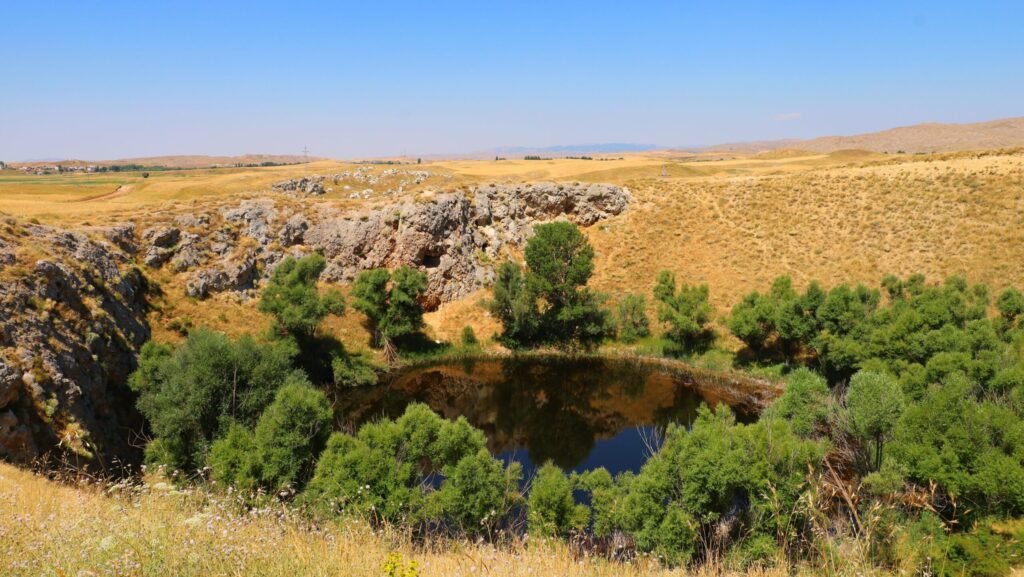
Some might look like a shallow cereal bowl. Others have steep or nearly vertical sides. Some remain dry. Others hold water and eventually become ponds.
And the hole we can see from the surface isn’t necessarily the whole story.
Underground cavities and channels can exist at different depths beneath the land. That’s one reason scientists can’t simply look at every suspicious depression in Florida and tell us exactly what is happening far below it.
It also explains why a little dip in your lawn doesn’t automatically mean there’s a cavern waiting to swallow your house.
Plenty of ordinary things can cause ground settling, including old buried debris, broken pipes, septic problems and poorly compacted soil. The Florida Geological Survey uses the broader term subsidence incident when a depression hasn’t been professionally verified as a true sinkhole.
So, there is no need to stare suspiciously at every low spot in the backyard.
Then There Was Winter Park
If you want to see what happens when a Florida sinkhole decides not to be subtle, we need to go to Winter Park in May 1981.
Late on the evening of May 8, a sinkhole appeared near South Denning Drive and West Fairbanks Avenue.
At first, it was about 40 feet across and 20 feet deep.
That’s already considerably more than a pothole.
Overnight, it grew to about 80 feet across.
Then things got interesting.
During the following morning, the sinkhole expanded dramatically. A U.S. Geological Survey report says that between approximately 10 a.m. and noon on May 9, it reached about 300 feet across and 110 feet deep.
The hole swallowed a house.
It undermined an automotive business.
Several Porsches went into it.
Parts of streets disappeared.
And then the community swimming pool began collapsing into the sinkhole.
When the swimming pool falls into the hole, you’ve officially lost the argument about whether the hole is getting bigger.
U.S. Geological Survey photographs documented the collapse while it was happening. Eventually the sinkhole stabilized. Other USGS descriptions put the enlarged feature at roughly 350 feet across and 75 feet deep, reflecting measurements after the shape of the hole had changed.
But the strangest part of the story may be what happened next.
The enormous hole began filling with water.
Yesterday’s Sinkhole Can Be Tomorrow’s Lake
Over the following weeks and months, the water level in the Winter Park sinkhole continued to rise.
Eventually, the former disaster site became Lake Rose.
And that’s not as unusual as it sounds.
The Southwest Florida Water Management District notes that many Florida lakes are actually relic sinkholes.
Which brings us to something you may have heard:
If you see a perfectly round pond or lake in Florida, it’s really a sinkhole.
Maybe.
An unusually round natural pond or lake can be a clue that you’re looking at an old sinkhole feature, but shape alone doesn’t prove it. Human-made ponds can be round, too, and bodies of water can develop their shapes for other reasons.
Still, sinkholes commonly produce circular or oval depressions. If one of those depressions reaches or holds groundwater, it can become a pond or lake.
Give it enough time and the transformation can be remarkable.
Vegetation grows around it. Fish and wildlife move in. Trees line the shore.
Eventually nobody drives past and says, “Look at that old sinkhole.”
They say, “That’s a pretty lake.”
And Yes, People Even Dive in Them
This needs one very important distinction.
If a new sinkhole suddenly opens in someone’s yard, do not put on scuba gear and climb into it.
A newly forming sinkhole can continue collapsing or expanding. Florida officials recommend keeping people and pets away from a suspected sinkhole and securing the area.
Old, stable, water-filled sinkhole features are another story.
Florida has springs and recreational diving sites associated with sinkhole and karst formations. Some can be explored by scuba divers under controlled conditions.
That doesn’t mean every underwater opening is safe to explore. Cavern and cave diving can involve overhead environments where a diver cannot simply swim straight to the surface. Some areas require specialized training, certification and equipment.
Still, it creates a very Florida progression.
First, the ground collapses.
Eventually, it fills with water.
Give it enough time and somebody may show up wearing flippers.
Thinking About Moving to Florida? There’s a Map for That
When people think about moving to Florida, they tend to research the obvious things.
How far is the house from the beach?
What’s the hurricane risk?
Is it in a flood zone?
How much is homeowners’ insurance going to cost?
And for some people, there’s another question:
What about sinkholes?
Florida actually provides maps that can help answer part of that question.
The Florida Geological Survey maintains an interactive map showing reported subsidence incidents throughout the state. You can zoom into an area and see where incidents have previously been reported.
There’s also statewide geological information showing areas where underlying conditions are more or less favorable for sinkhole formation.
For some people moving to Florida, those maps become part of the house-hunting process. They’ll check flood maps, insurance costs, hurricane exposure and sinkhole information before deciding where they want to live.
Other people know sinkholes exist and aren’t particularly concerned about them.
That’s fine, too.
The important thing is knowing that the information is available if it matters to you.
There is also a limitation worth understanding before staring too intently at all those dots on a map.
A reported subsidence incident isn’t necessarily a confirmed sinkhole. Many reports have never been inspected by a professional geologist, and some ground depressions ultimately have completely different explanations.
The map isn’t a record of every sinkhole that has ever existed in Florida, either. Reporting isn’t comprehensive.
And if there are no dots around a particular house, that doesn’t mean the property has received an official lifetime guarantee from the ground.
The maps are another piece of information, not a crystal ball.
Florida Isn’t Quite as Flat as It Looks
Perhaps that’s the most interesting thing about sinkholes.
Florida appears almost ridiculously flat when we drive across it, but beneath that flat surface is a complicated landscape shaped by moving groundwater and dissolving limestone.
There are cavities we will never see, underground drainage routes, caves, springs and passages through rock.
Most of them will never cause any trouble at all.
Occasionally, however, something changes underground and the surface follows.
Sometimes the result is a shallow depression.
Sometimes it’s a pond.
Sometimes it’s a lake.
Sometimes people eventually put on scuba tanks and explore it.
And once in a while, Florida eats a Porsche.
Sources
- Florida Geological Survey, Florida Department of Environmental Protection, Sinkholes and Sinkhole FAQ
- Florida Geological Survey, Subsidence Incident Reports
- Florida Geological Survey, Sinkhole Research
- U.S. Geological Survey, Sinkholes
- U.S. Geological Survey, Winter Park Florida Sinkhole of 1981
- Southwest Florida Water Management District, Sinkholes
Editorial Review
Reviewed by Claire Bennett, Managing Editor
Last reviewed: October 2026
Quick Answer Guide publishes practical, research-based answers to common questions about money, technology, health, travel, home improvement, and everyday life. Content is reviewed using official government resources, educational institutions, industry publications, and other authoritative sources when appropriate. Articles are updated periodically to improve accuracy and usefulness.